Tree Shaking Internals
How bundlers use static analysis of ES module imports to eliminate dead code, what prevents tree shaking, the PURE annotation, Turbopack vs Webpack differences, and how to verify it's working.
Overview
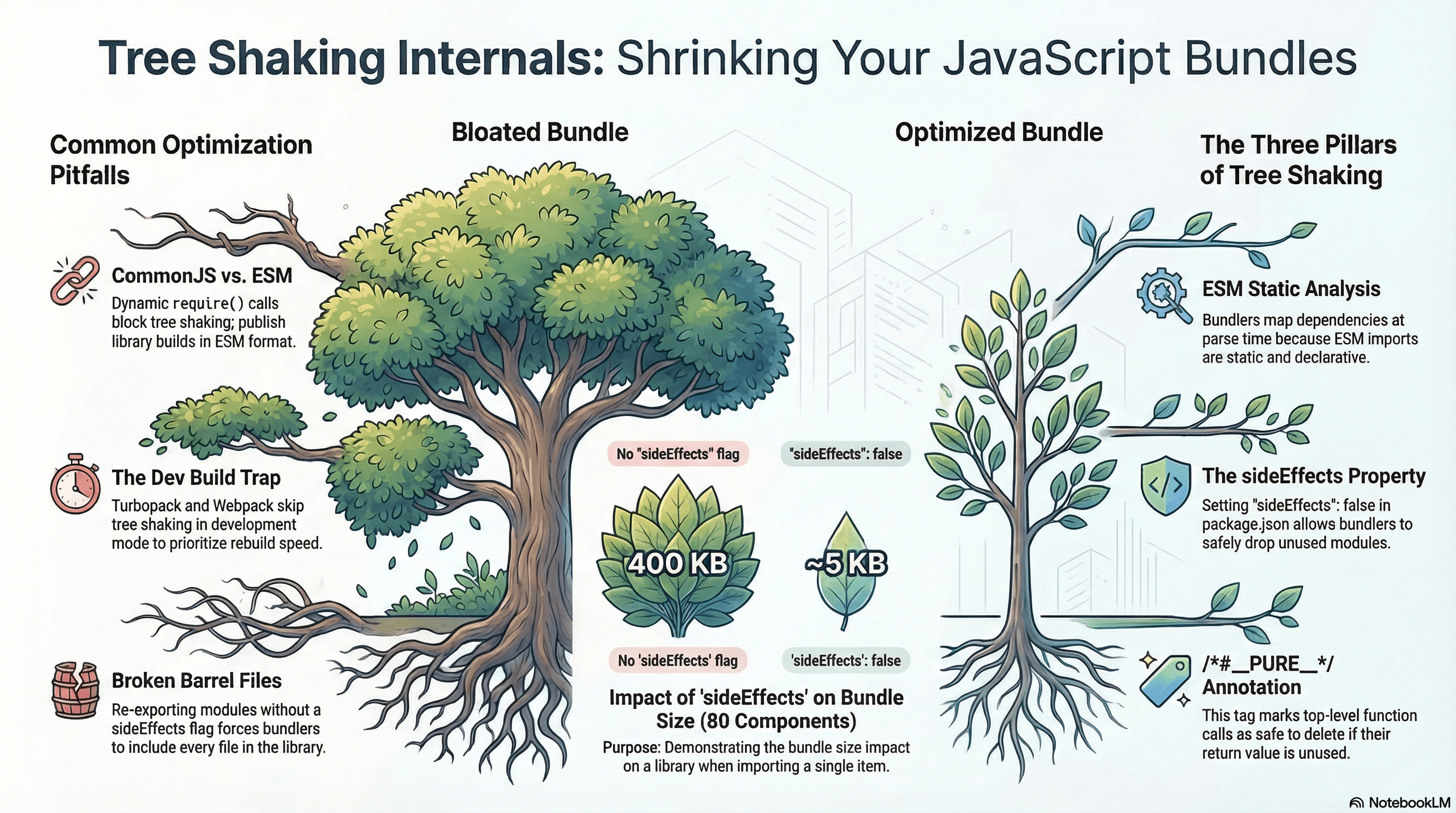
Tree shaking is the process by which a bundler statically analyzes your import/export graph and removes any exported code that is never imported anywhere in your application. The result is a smaller bundle — sometimes dramatically smaller — because unused utilities, components, and library exports never make it to production.
Tree shaking is not magic. It has strict prerequisites, and code that looks clean can silently opt out of it. Understanding why it works — and why it fails — is the difference between a 400KB bundle and an 80KB one.
How It Works
ESM Static Analysis
Tree shaking relies on ES Modules — specifically the static nature of import and export statements. Unlike CommonJS require(), which can be called anywhere at runtime, ESM imports are resolved at parse time. This lets a bundler build a complete dependency graph before executing any code.
// Bundler can see at parse time: only `formatCurrency` is used
import { formatDate, formatCurrency, slugify } from "./utils";
// formatDate and slugify → marked as dead code if unused anywhere
When formatDate and slugify have no other importers, they are excluded from the output. This is dead code elimination driven by the module graph.
Side Effects: The Critical Signal
A module has a side effect if importing it does something beyond exporting values — patching Array.prototype, registering event listeners, writing to a global store, injecting CSS. Bundlers conservatively keep any module that might have side effects, even if none of its exports are used.
The sideEffects field in package.json controls this:
// package.json — tells the bundler all files are safe to drop if unused
{ "sideEffects": false }

// Allowlist specific files that do have side effects
{ "sideEffects": ["./src/polyfills.ts", "*.css"] }
Without "sideEffects": false, a bundler cannot safely drop an unused module — it must assume the module's top-level code matters even if no exports are consumed.
Scope Hoisting
After dead code is removed, bundlers like Rollup flatten surviving modules into a single scope — scope hoisting. This eliminates module wrapper functions and gives the minifier a complete view of all variable references, enabling further inlining and renaming. Webpack 5 calls this "Module Concatenation."
/*#__PURE__*/ — Annotating Side-Effect-Free Calls
When a function call at the module top level could theoretically have a side effect, bundlers include it even if its return value is unused. The /*#__PURE__*/ annotation tells the bundler the call is safe to drop:
// Without annotation — bundler includes this call even if MyClass is unused
// because `createClass(...)` might have side effects
export const MyClass = createClass({ methods: {} });

// With annotation — bundler knows it's safe to eliminate if MyClass is unused
export const MyClass = /*#__PURE__*/ createClass({ methods: {} });
Babel and TypeScript transpilers add #__PURE__ automatically for class expressions and certain helper calls. Libraries like React use it on React.createElement calls in the generated output — which is why unused React components tree-shake correctly.
Code Examples
Tree-Shakeable Utility Module
// src/utils/format.ts
// Each function is a named export — bundler tracks usage per-binding

export function formatDate(date: Date): string {
  return new Intl.DateTimeFormat("en-US", {
    year: "numeric",
    month: "short",
    day: "numeric",
  }).format(date);
}

export function formatCurrency(amount: number, currency = "USD"): string {
  return new Intl.NumberFormat("en-US", {
    style: "currency",
    currency,
  }).format(amount);
}

export function slugify(text: string): string {
  return text
    .toLowerCase()
    .replace(/\s+/g, "-")
    .replace(/[^\w-]/g, "");
}
// app/products/page.tsx — only formatCurrency imported
// formatDate and slugify are dead code — excluded from the bundle
import { formatCurrency } from "@/utils/format";
export default function ProductsPage() {
return <p>Price: {formatCurrency(4999)}</p>;
}What Prevents Tree Shaking
// ❌ Default object export — bundler cannot tell which properties are used
const utils = { formatDate, formatCurrency, slugify };
export default utils;

// ❌ CommonJS — dynamic require() prevents static analysis
module.exports = { formatDate, formatCurrency, slugify };
const { formatCurrency } = require("./utils"); // entire module included

// ❌ Dynamic import with computed key — bundler must include entire module
const mod = await import("./utils");
const fn = mod[someVariable]; // which export? unknown at parse time

// ❌ Re-export barrel without sideEffects declaration
// If sideEffects is not set to false, bundler keeps all re-exports
export * from "./button";
export * from "./input";
export * from "./modal"; // all three modules included regardless of usage
CSS Side Effects — The Correct Allowlist
CSS files imported in JavaScript always have side effects (they inject styles globally). Without the allowlist, setting "sideEffects": false drops imported CSS:
// package.json — correct config for a UI library with CSS
{
  "sideEffects": ["*.css", "*.scss", "./src/styles/**"]
}
// components/Button.tsx
import "./button.css"; // side-effectful import — must be in the allowlist
export function Button() {
/* ... */
}Rollup treeshake Configuration
For library authors using Rollup directly, the treeshake option controls how aggressively dead code is eliminated:
// rollup.config.ts
import { defineConfig } from "rollup";
import typescript from "@rollup/plugin-typescript";

export default defineConfig({
  input: "src/index.ts",
  output: [
    { file: "dist/index.esm.js", format: "esm" }, // ESM — required for consumer tree shaking
    { file: "dist/index.cjs.js", format: "cjs" }, // CJS — for Node.js compat
  ],
  treeshake: {
    // Treat all module-level calls as pure (safe to drop if result unused)
    // Only safe if you know your code has no top-level side effects
    moduleSideEffects: false,
    // Mark specific packages as having no side effects
    // propertyReadSideEffects: false,
  },
  plugins: [typescript()],
  // Mark peer dependencies as external — don't bundle them
  external: ["react", "react-dom"],
});
Verifying Tree Shaking is Working
# Build with source maps and check what's in the output
ANALYZE=true next build

# Use bundle-buddy or source-map-explorer to inspect what survived
npx source-map-explorer .next/static/chunks/*.js

# For library builds: check Rollup's output directly
npx rollup src/index.ts --format esm | grep "formatDate"
# If formatDate appears and it shouldn't be there — tree shaking failed
// rollup.config.ts — add visualizer for interactive inspection
import { visualizer } from "rollup-plugin-visualizer";
plugins: [
visualizer({
filename: "dist/bundle-stats.html",
open: true, // auto-open after build
gzipSize: true, // show gzipped sizes
brotliSize: true, // show brotli sizes
}),
];Library package.json for Maximum Tree-Shakability
// package.json of a shared UI library
{
  "name": "@acme/ui",
  "version": "2.0.0",
  "main": "dist/index.cjs.js", // CJS — for Node.js and older bundlers
  "module": "dist/index.esm.js", // ESM — used by modern bundlers for tree shaking
  "types": "dist/index.d.ts",
  "exports": {
    ".": {
      "import": "./dist/index.esm.js", // ESM path (import statement)
      "require": "./dist/index.cjs.js", // CJS path (require())
      "types": "./dist/index.d.ts"
    },
    "./button": {
      "import": "./dist/button.esm.js", // granular entry — imports only Button
      "require": "./dist/button.cjs.js"
    }
  },
  "sideEffects": ["*.css"] // only CSS has side effects
}
Turbopack vs Webpack 5 — Tree Shaking Differences
Next.js 13+ ships with Turbopack as the default dev bundler (stable in Next.js 15). Production builds still use Webpack 5 by default, with Turbopack production support in progress.
Webpack 5: Full tree shaking via usedExports and optimization.sideEffects. sideEffects in package.json is respected. Module Concatenation (scope hoisting) enabled in production mode.
Turbopack (dev): Incremental bundler optimized for speed. In development, it deliberately skips tree shaking for rebuild performance — dead code is included in dev builds. This means a component that appears in your dev bundle may not appear in the production bundle, and vice versa. Always verify tree shaking on production builds, not dev builds.
// next.config.ts — to use Turbopack in dev (default in Next.js 15)
const nextConfig = {
  // turbopack is the default for `next dev` in Next.js 15
  // For custom config:
  turbopack: {
    resolveAlias: {
      // custom module aliases for Turbopack
    },
  },
};
Real-World Use Case
Design system with 80 components. If you export everything from a single barrel file without "sideEffects": false, an app that imports only <Button> bundles all 80 components. With "sideEffects": false and proper ESM exports, the consumer's bundler includes only Button and its direct dependencies. For a library with 80 components averaging 5KB each (400KB total), this drops the app's contribution from the library from 400KB to ~5KB.
Common Mistakes / Gotchas
1. Publishing CJS-only. Without a "module" or "exports"."import" field, tree shaking cannot work for your library consumers — even if their bundler supports it. Always publish an ESM build.
2. Barrel files without sideEffects. A barrel file (export * from './components') is safe only if the library declares "sideEffects": false. Without it, bundlers keep everything.
3. Verifying on dev builds. Turbopack and Webpack in development mode skip tree shaking for speed. Always run next build (production) to verify dead code is actually eliminated.
4. CSS imports breaking sideEffects: false. Setting "sideEffects": false without allowlisting CSS files causes imported CSS to be dropped. Always allowlist *.css and *.scss.
5. Inline require() blocking static analysis. Any require() inside a function body is dynamic and prevents the bundler from seeing what's imported — the entire required module is included.
Summary
Tree shaking works by statically analyzing ESM import/export graphs to eliminate code with no live references. It requires ESM — CommonJS cannot be tree shaken. The sideEffects field in package.json is the key signal: false tells bundlers it's safe to drop unused modules; missing means conservative inclusion. The /*#__PURE__*/ annotation marks top-level function calls as side-effect-free, making class and factory patterns shakeable. CSS imports are side-effectful and must be allowlisted. Turbopack skips tree shaking in development — always verify on production builds. Library authors should publish both ESM and CJS builds with correct exports fields.
Interview Questions
Q1. Why does tree shaking require ESM and not work with CommonJS?
ESM import and export statements are static — they appear at the top level, their source is a string literal, and the bindings they expose are known at parse time. A bundler can build a complete import/export graph before executing any code. CommonJS require() is a function call — it can be inside conditions, loops, or closures, receiving dynamic arguments. The bundler cannot know at parse time which module will be required or which properties will be accessed. Since the full graph is unknowable, the entire required module must be included. The "module" field in package.json specifies an ESM build alongside the CJS "main" — this is what modern bundlers use for tree shaking.
Q2. What is the sideEffects field in package.json and why is it critical for library authors?
sideEffects tells the bundler whether it's safe to drop files whose exports are unused. "sideEffects": false means every file in the package is safe to exclude if nothing imports from it. Without this field, bundlers assume any file might have side effects (global mutations, event listeners) and include all imported files regardless of whether their exports are used. For a library with 80 components, an app that uses only one component would bundle all 80 if sideEffects is missing — because the bundler can't safely drop the others. CSS files are always side-effectful and must be allowlisted: "sideEffects": ["*.css"].
Q3. What does /*#__PURE__*/ do and when does it appear in compiled output?
/*#__PURE__*/ annotates a function call as having no side effects — it's safe to eliminate if its return value is unused. Without it, a top-level call like export const MyClass = createClass({}) must be kept even if MyClass is never imported, because createClass() could mutate globals. With /*#__PURE__*/, the bundler knows the call's only effect is producing its return value and can eliminate it with the unused binding. Babel and TypeScript add this annotation automatically for class expressions, React JSX transforms (React.createElement), and helper calls generated by @babel/plugin-transform-class-properties. Library users see it in compiled library output and can rely on it for correct tree shaking of class-based code.
Q4. How does scope hoisting improve bundle size beyond dead code elimination?
Scope hoisting (Rollup's term; "Module Concatenation" in Webpack) flattens multiple ESM modules into a single scope after tree shaking. Without it, each module is wrapped in a factory function — there's overhead for each module boundary and the minifier can't inline constants across module boundaries. With scope hoisting, all surviving code is in one scope: the minifier can see all variable references simultaneously, inline single-use functions and constants, and apply more aggressive renaming. A bundle with 200 modules that would otherwise have 200 factory functions produces smaller, faster output when flattened — both from eliminating the wrapper overhead and from improved minification.
Q5. Why should you not verify tree shaking results in development builds?
Development bundlers prioritize rebuild speed over bundle optimization. Turbopack (Next.js 15 default dev bundler) deliberately skips tree shaking and dead code elimination to minimize incremental rebuild time — a save that would take 50ms with tree shaking takes 5ms without it. Webpack in development mode also enables fewer optimizations. This means your dev bundle includes dead code that will be eliminated in production, and the dev bundle size is not a reliable indicator of the production bundle size. Always verify tree shaking with next build (production mode) — use ANALYZE=true next build to inspect the treemap for code that should have been eliminated.
Q6. What causes a barrel file to break tree shaking and how do you fix it?
A barrel file like export * from './button'; export * from './input'; export * from './modal' re-exports from multiple source files. The issue: if any of those source files might have side effects (and sideEffects is not declared as false in package.json), the bundler must include all of them when any export from the barrel is imported — it can't safely exclude files it hasn't verified are side-effect-free. The fixes: (1) declare "sideEffects": false (with CSS allowlist) in the library's package.json so bundlers know they can drop re-exported files if their exports go unused; (2) use granular imports (import { Button } from "@acme/ui/button") instead of barrel imports — this bypasses the barrel entirely and imports only the specific file; (3) if you control the library, use subpath exports in package.json to expose per-component entry points.
Overview
How code travels from your editor to the browser — build tooling, bundle optimization, and delivery infrastructure.
Code Splitting Strategies
Route-level, component-level, and vendor splitting — how next/dynamic and React.lazy work, webpack magic comments for chunk naming and prefetch, loading.tsx integration, and when splitting hurts more than it helps.