Promise Combinators
How Promise.all, Promise.allSettled, Promise.any, and Promise.race work, when to use each, and how errors propagate differently through every combinator.
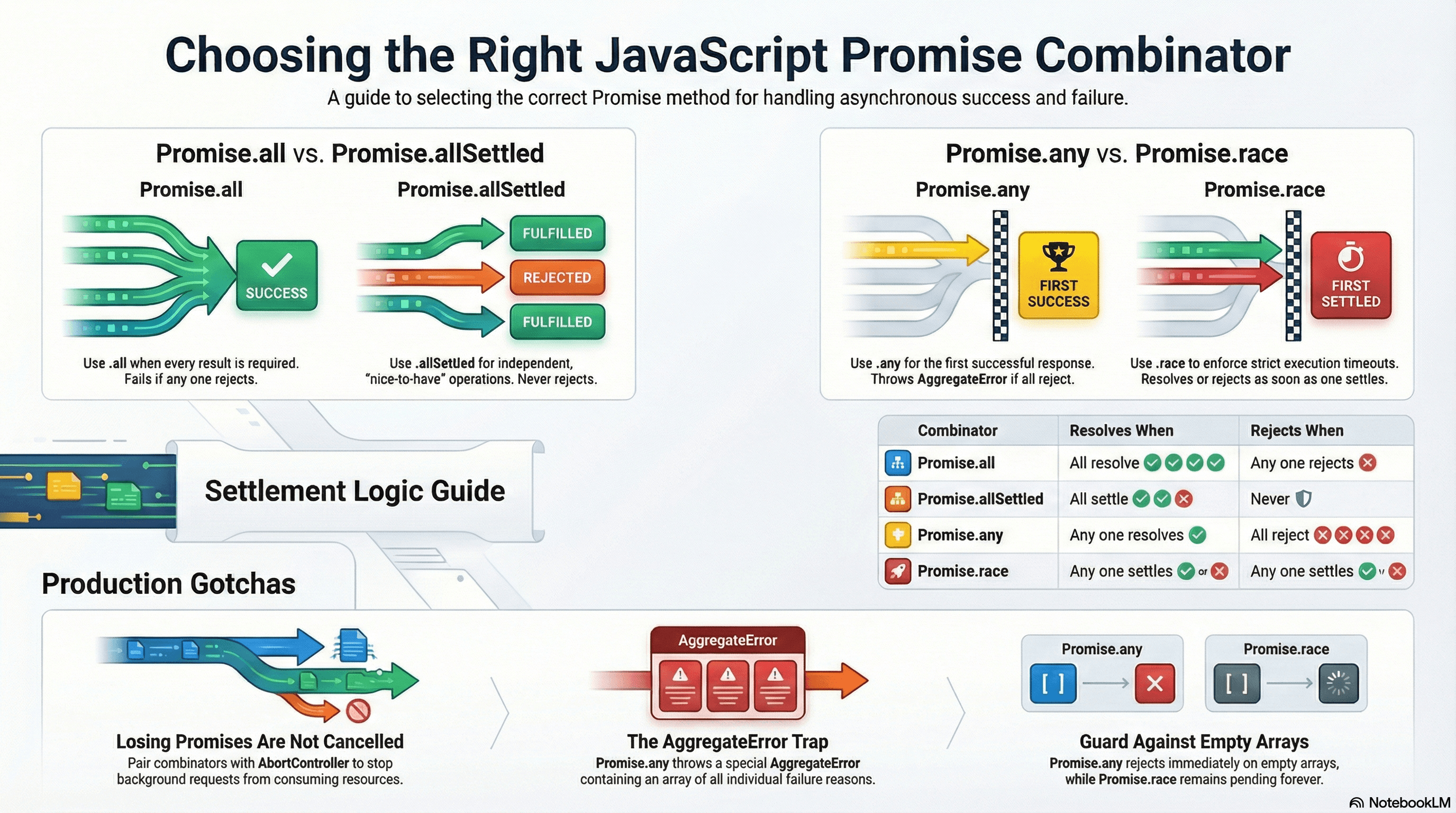
Overview
Before combinators existed, coordinating multiple async operations meant nesting callbacks or chaining Promises manually — brittle, hard to read, and easy to get wrong. Promise combinators give you a clean, declarative way to run async operations in parallel and express exactly what success and failure mean for your specific use case.
JavaScript ships four built-in combinators: Promise.all, Promise.allSettled, Promise.any, and Promise.race. They look similar — all four accept an iterable of Promises and return a single new Promise — but they differ in one critical dimension: what they do with rejections. Picking the wrong one is one of the most common sources of silent failures and data loss in production async code.
This article builds on the event loop and microtask knowledge from earlier articles. Every combinator creates Promise chains under the hood, and understanding how microtasks sequence their callbacks will help you reason about their behavior under failure conditions.
How It Works
All four combinators accept an iterable of Promises and return a single Promise. They differ in when they settle and what they do with rejections:
| Combinator | Resolves when | Rejects when | Use when |
|---|---|---|---|
Promise.all | All resolve | Any one rejects | Every result is required |
Promise.allSettled | All settle (either way) | Never | Results are independent |
Promise.any | Any one resolves | All reject (AggregateError) | First success wins |
Promise.race | Any one settles | Any one rejects first | Timeout enforcement |
One important behavior shared by all four: the losing Promises are not cancelled. If you fire three fetch requests and Promise.race resolves with the fastest one, the other two keep running in the background, consuming bandwidth and server resources. If that matters — and it usually does — pair combinators with AbortController.
Code Examples
Promise.all — All or Nothing
Use Promise.all when every result is required to proceed. A single rejection immediately rejects the returned Promise and discards all other results.
// lib/dashboard.ts

interface User {
  id: string;
  name: string;
  email: string;
}

interface Orders {
  total: number;
  items: string[];
}

interface Notifications {
  unread: number;
}

async function fetchDashboardData(userId: string): Promise<{
  user: User;
  orders: Orders;
  notifications: Notifications;
}> {
  // All three requests fire in parallel — not sequentially.
  // If any one rejects, the entire Promise.all rejects immediately.
  const [user, orders, notifications] = await Promise.all([
    fetch(`/api/users/${userId}`).then((res) => {
      if (!res.ok) throw new Error(`User fetch failed: ${res.status}`);
      return res.json() as Promise<User>;
    }),
    fetch(`/api/orders?userId=${userId}`).then((res) => {
      if (!res.ok) throw new Error(`Orders fetch failed: ${res.status}`);
      return res.json() as Promise<Orders>;
    }),
    fetch(`/api/notifications?userId=${userId}`).then((res) => {
      if (!res.ok) throw new Error(`Notifications fetch failed: ${res.status}`);
      return res.json() as Promise<Notifications>;
    }),
  ]);

  return { user, orders, notifications };
}
Promise.all rejects with the first rejection reason and silently
discards all others. If three requests fail simultaneously, you only learn
about one of them. For independent operations where you need full failure
visibility, use Promise.allSettled.
Promise.allSettled — Full Outcome Visibility
Use Promise.allSettled when operations are independent and you want to handle each success and failure individually. It never rejects — it waits for every Promise to settle and gives you a result descriptor for each.
// lib/notifications.ts

interface SendResult {
  userId: string;
  messageId?: string;
  error?: string;
}

async function sendBulkNotifications(
  userIds: string[],
): Promise<{ sent: string[]; failed: SendResult[] }> {
  const results = await Promise.allSettled(
    userIds.map((userId) =>
      fetch("/api/email/send", {
        method: "POST",
        headers: { "Content-Type": "application/json" },
        body: JSON.stringify({ userId }),
      }).then((res) => {
        if (!res.ok) throw new Error(`HTTP ${res.status} for user ${userId}`);
        return res.json() as Promise<{ messageId: string }>;
      }),
    ),
  );

  const sent: string[] = [];
  const failed: SendResult[] = [];

  results.forEach((result, index) => {
    const userId = userIds[index];

    if (result.status === "fulfilled") {
      sent.push(userId);
    } else {
      // result.reason is the thrown Error — always log it, never silently discard
      console.error(
        `Notification failed for ${userId}:`,
        result.reason.message,
      );
      failed.push({ userId, error: result.reason.message });
    }
  });

  return { sent, failed };
}
Each item in the allSettled result array is either { status: "fulfilled", value: T } or { status: "rejected", reason: unknown }. TypeScript narrows the type correctly when you check result.status.
Promise.any — First Success Wins
Use Promise.any when you have multiple sources that can serve the same result and you want whichever responds successfully first. It only rejects if every Promise rejects — and when that happens, it throws an AggregateError containing all the individual failures.
// lib/geo.ts

interface GeoLocation {
  lat: number;
  lng: number;
  city: string;
  country: string;
}

async function resolveLocation(ip: string): Promise<GeoLocation> {
  try {
    // Race three geolocation providers — use the first successful response.
    // Slow or failed providers are ignored as long as one succeeds.
    const location = await Promise.any([
      fetch(`https://geo-provider-a.example.com/lookup?ip=${ip}`).then((r) => {
        if (!r.ok) throw new Error(`Provider A failed: ${r.status}`);
        return r.json() as Promise<GeoLocation>;
      }),
      fetch(`https://geo-provider-b.example.com/lookup?ip=${ip}`).then((r) => {
        if (!r.ok) throw new Error(`Provider B failed: ${r.status}`);
        return r.json() as Promise<GeoLocation>;
      }),
      fetch(`https://geo-provider-c.example.com/lookup?ip=${ip}`).then((r) => {
        if (!r.ok) throw new Error(`Provider C failed: ${r.status}`);
        return r.json() as Promise<GeoLocation>;
      }),
    ]);

    return location;
  } catch (error) {
    // Promise.any throws AggregateError — not a plain Error — when ALL reject.
    // error.errors is an array of every individual rejection reason.
    if (error instanceof AggregateError) {
      const messages = error.errors.map((e: Error) => e.message).join("; ");
      throw new Error(`All geolocation providers failed: ${messages}`);
    }
    throw error;
  }
}
Always handle AggregateError explicitly when using Promise.any. It's the
only combinator that throws this special error type. If your catch block only
accesses error.message, you'll see the generic message "All promises were rejected" — not the actual failure reasons. Access error.errors for the
full breakdown.
Promise.race — First Settlement Wins (Timeout Pattern)
Promise.race resolves or rejects with the first Promise that settles — regardless of whether it resolved or rejected. Its most practical use is enforcing a deadline on an async operation.
// lib/timeout.ts

function withTimeout<T>(promise: Promise<T>, ms: number): Promise<T> {
  const timeout = new Promise<never>((_, reject) =>
    setTimeout(
      () => reject(new Error(`Operation timed out after ${ms}ms`)),
      ms,
    ),
  );

  // First to settle wins — either the real result or the timeout error
  return Promise.race([promise, timeout]);
}

// Usage
async function fetchWithDeadline(url: string): Promise<unknown> {
  try {
    const data = await withTimeout(
      fetch(url).then((res) => {
        if (!res.ok) throw new Error(`HTTP ${res.status}`);
        return res.json();
      }),
      5000,
    );
    return data;
  } catch (error) {
    if (error instanceof Error && error.message.includes("timed out")) {
      throw new Error(`Request to ${url} exceeded the 5s deadline`);
    }
    throw error;
  }
}
Promise.race does not cancel the losing Promises — they continue running in
the background. For fetch requests, this means the HTTP request keeps
consuming bandwidth and server resources even after the race is decided.
Always pair race-based timeouts with AbortController to actually cancel
losing requests.
Production Pattern — Timeout with AbortController
The correct production implementation of a timeout combines Promise.race for the deadline logic with AbortController to clean up the losing request:
// lib/abortable-fetch.ts

async function fetchWithAbortableTimeout(
  url: string,
  timeoutMs: number,
): Promise<unknown> {
  const controller = new AbortController();

  // Schedule the abort — this cancels the actual HTTP request after timeoutMs
  const timeoutId = setTimeout(() => controller.abort(), timeoutMs);

  try {
    const response = await fetch(url, { signal: controller.signal });

    if (!response.ok) throw new Error(`HTTP ${response.status}`);

    return await response.json();
  } catch (error) {
    // AbortError is thrown when controller.abort() fires
    if (error instanceof DOMException && error.name === "AbortError") {
      throw new Error(`Request to ${url} was aborted after ${timeoutMs}ms`);
    }
    throw error;
  } finally {
    // Always clear the timeout — if fetch succeeded before the deadline,
    // we don't want the setTimeout firing and aborting future requests
    clearTimeout(timeoutId);
  }
}
Composing Combinators — Mixing Required and Optional Data
In real applications, some data is critical and some is optional. You can compose combinators to express this precisely:
// app/products/[slug]/page.tsx

import { notFound } from "next/navigation";

async function fetchProduct(slug: string) {
  const res = await fetch(`/api/products/${slug}`);
  if (!res.ok) return null;
  return res.json();
}

async function fetchCart() {
  const res = await fetch("/api/cart");
  if (!res.ok) throw new Error(`Cart fetch failed: ${res.status}`);
  return res.json();
}

async function fetchWishlist() {
  const res = await fetch("/api/wishlist");
  if (!res.ok) throw new Error(`Wishlist fetch failed: ${res.status}`);
  return res.json();
}

export default async function ProductPage({
  params,
}: {
  params: { slug: string };
}) {
  // Product and cart are critical — both must succeed.
  // Wishlist is optional — a failure here should not break the page.
  const [[product, cart], wishlistResult] = await Promise.all([
    // Inner Promise.all: both must succeed or the page fails entirely
    Promise.all([fetchProduct(params.slug), fetchCart()]),

    // Wishlist is wrapped to never throw — we handle its failure inline
    fetchWishlist().then(
      (data) => ({ status: "fulfilled" as const, value: data }),
      (error) => ({ status: "rejected" as const, reason: error as Error }),
    ),
  ]);

  if (!product) notFound();

  const wishlistItems =
    wishlistResult.status === "fulfilled" ? wishlistResult.value : [];

  if (wishlistResult.status === "rejected") {
    // Log the failure but don't surface it to the user
    console.error("Wishlist unavailable:", wishlistResult.reason.message);
  }

  return <ProductView product={product} cart={cart} wishlist={wishlistItems} />;
}
Real-World Use Case
Choosing the right combinator for a dashboard page. A product detail page in an e-commerce app needs: the product itself, the logged-in user's cart, and their saved wishlist.
Promise.allfor product + cart — the page cannot render without both. A missing cart means you can't show "Add to Cart" state correctly. Fail fast and show an error boundary.Promise.allSettledstyle for the wishlist — it's a nice-to-have. If the wishlist service is down, render the heart icon in its default empty state and log the failure silently.Promise.anyif you have a CDN edge cache and an origin server both capable of serving product data — use whichever responds successfully first.Promise.race+AbortControlleron any of these calls where you want to enforce an SLA — fail explicitly if a service takes longer than 3 seconds rather than letting the page hang.
Common Mistakes / Gotchas
1. Using Promise.all when partial failure is acceptable.
If you fire 10 independent requests with Promise.all and one fails, you lose all 10 results even though 9 succeeded. For independent side effects — sending emails, writing logs, updating separate records — always use Promise.allSettled so you can process the successful results.
2. Not handling AggregateError from Promise.any.
Promise.any throws AggregateError, not a plain Error, when every Promise rejects. Its message property says "All promises were rejected" with no detail. The individual failure reasons are in error.errors. If you don't check for AggregateError specifically, you'll lose all the diagnostic information.
3. Assuming Promise.race cancels the losing requests.
It doesn't. Winning the race only determines which result your code receives — the other Promises keep running. If they're fetch calls, those HTTP connections stay open until the server responds. For timeout patterns, use AbortController to actually cancel the request.
4. Writing sequential await instead of parallel combinators.
This is the most common performance mistake in async code:
// ❌ Sequential — total time = time(fetchUser) + time(fetchOrders) + time(fetchPrefs)
const user = await fetchUser(id);
const orders = await fetchOrders(id);
const prefs = await fetchPreferences(id);

// ✅ Parallel — total time = max(time(fetchUser), time(fetchOrders), time(fetchPrefs))
const [user, orders, prefs] = await Promise.all([
  fetchUser(id),
  fetchOrders(id),
  fetchPreferences(id),
]);
The three requests are independent — there's no reason to wait for one before starting the next.
5. Silently swallowing errors in Promise.allSettled.
allSettled never rejects, which makes it deceptively easy to lose errors. Always log or report rejected results — even when partial failure is acceptable, silent failure makes debugging production issues extremely difficult.
// ❌ Errors vanish silently
results.forEach((r) => {
  if (r.status === "fulfilled") process(r.value);
});

// ✅ Failures are visible
results.forEach((r) => {
  if (r.status === "fulfilled") {
    process(r.value);
  } else {
    console.error("Operation failed:", r.reason);
    reportToMonitoring(r.reason);
  }
});
6. Passing an empty array to Promise.any.
Promise.any([]) rejects immediately with an AggregateError containing an empty errors array. If the source of your Promise array is dynamic (e.g., a filtered list), guard against the empty case:
if (providers.length === 0) throw new Error("No providers available");
const result = await Promise.any(providers.map(fetchFrom));
Summary
The four Promise combinators all accept an iterable of Promises and return a single Promise, but they express fundamentally different attitudes toward failure. Promise.all is all-or-nothing — use it when every result is required. Promise.allSettled gives you full outcome visibility across independent operations that shouldn't block each other. Promise.any is an optimistic redundancy pattern — the first success wins, and only a complete set of failures produces an error. Promise.race settles on the first outcome in either direction, making it the natural fit for timeout enforcement, always paired with AbortController to clean up losing requests. Matching the combinator to your actual error tolerance is what separates resilient async code from code that silently loses data under partial failure.
Interview Questions
Q1. What is the difference between Promise.all and Promise.allSettled? When would you choose each?
Promise.all rejects as soon as any one Promise rejects — you get the first rejection reason and lose all other results, including successful ones. Use it when every result is required and a single failure should abort the whole operation. Promise.allSettled waits for every Promise to settle regardless of outcome and gives you a result descriptor for each. Use it when operations are independent and you need to handle each success and failure individually — for example, sending bulk notifications where you want to know exactly which ones succeeded and which failed, not just that one failed.
Q2. What does Promise.any throw when all Promises reject, and why does it matter?
It throws an AggregateError — a special error type with an errors property that contains an array of every individual rejection reason. This matters because a regular catch(error) that only reads error.message will give you the generic string "All promises were rejected" with no diagnostic detail. You need to explicitly check error instanceof AggregateError and access error.errors to get the actual failure reasons from each Promise. Not handling AggregateError specifically is a common source of hard-to-debug production failures.
Q3. Does Promise.race cancel the losing Promises?
No. Promise.race only determines which result your code receives — the other Promises continue executing in the background regardless. If they're fetch requests, those HTTP connections stay open and the server still processes them. For timeout patterns where you want to actually cancel the underlying request, you need AbortController: schedule controller.abort() in a setTimeout, pass controller.signal to fetch, and clear the timeout in a finally block when the fetch completes before the deadline.
Q4. Why is sequential await a performance problem and how do you fix it?
Sequential await means each operation starts only after the previous one completes, so the total time is the sum of all operation durations. If three API calls each take 200ms, sequential await takes 600ms total. When the operations are independent — they don't need each other's results — there's no reason to sequence them. Using Promise.all fires all three simultaneously and the total time becomes the duration of the slowest one, typically ~200ms. This is one of the highest-impact, lowest-effort performance improvements in async code.
Q5. How would you structure a page data fetch where some data is required and some is optional?
Use a composition of combinators. Wrap required data in an inner Promise.all — if any critical data fetch fails, the whole thing fails and you can show an error boundary. Wrap optional data fetches in .then(value => ({ status: "fulfilled", value }), error => ({ status: "rejected", reason: error })) to prevent them from rejecting the outer Promise. Then combine both groups in an outer Promise.all. This gives you a single await point where required failures propagate naturally and optional failures are captured and handled inline.
Q6. What happens if you pass an empty array to Promise.all, Promise.allSettled, Promise.any, and Promise.race?
Promise.all([]) resolves immediately with an empty array. Promise.allSettled([]) resolves immediately with an empty array. Promise.any([]) rejects immediately with an AggregateError containing an empty errors array — because there are no Promises to succeed. Promise.race([]) returns a Promise that never settles — it stays pending forever because there are no competitors. These edge cases matter when your input array is dynamically generated and could be empty at runtime.
Task Starvation & Scheduler Priorities
How JavaScript's event loop scheduler prioritizes work, what causes task starvation, how the browser and React assign priorities, and how to write code that stays responsive under load.
Async / Await & Error Handling
How async/await works under the hood, the full range of error handling patterns, common failure modes in async code, and how to write async functions that fail predictably.