Overview
The attack vectors and mitigations most relevant to frontend engineers — from active exploits and browser-enforced policy headers, through code-level injection defences, to secrets hygiene and supply chain integrity.
Security
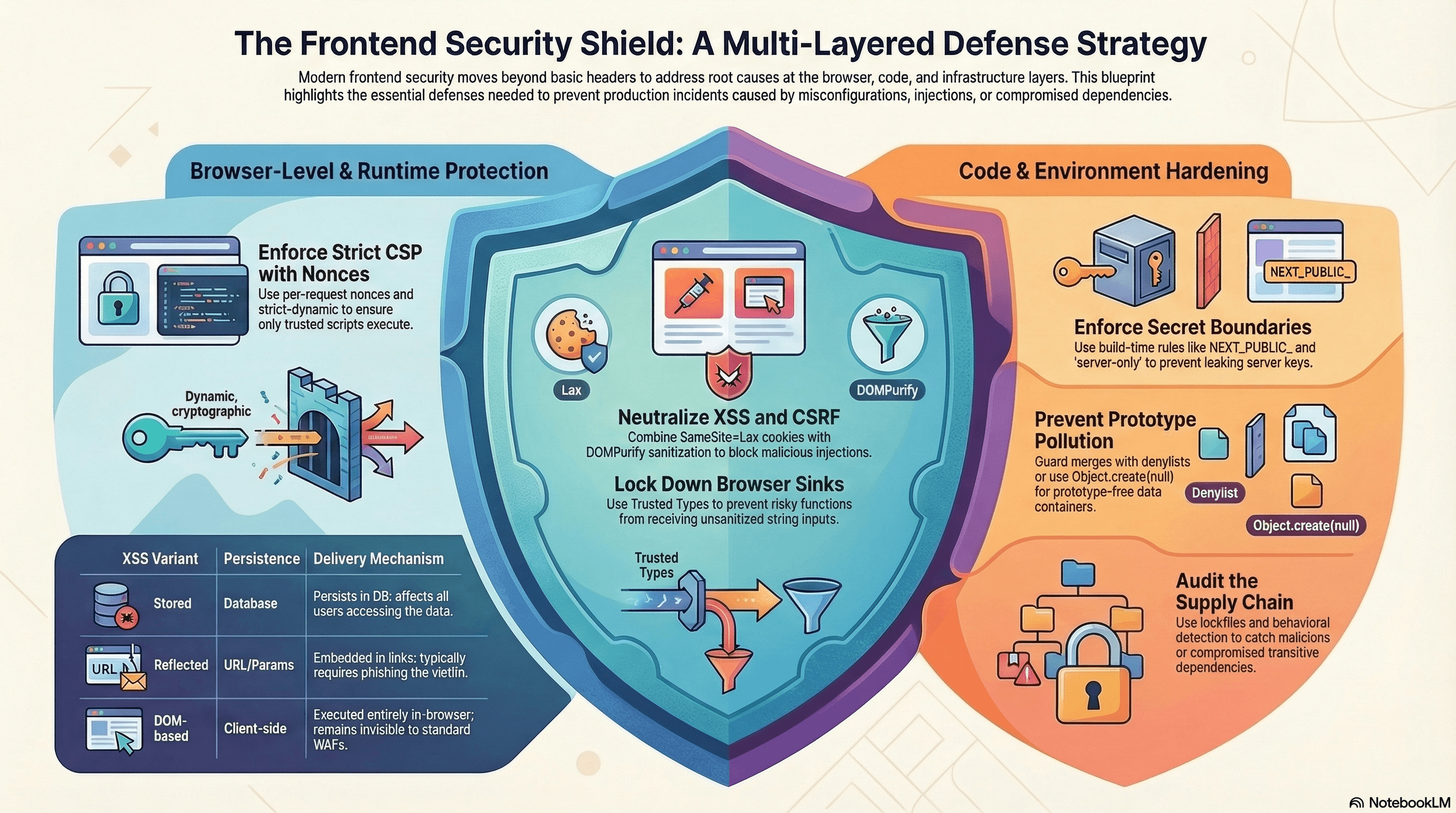
Frontend security is not just headers and libraries — it's understanding how attacks work at the browser level and building defences that address root causes rather than symptoms. A misconfigured cookie, a missing sanitisation step, a leaked API key, or a single compromised transitive dependency can all result in production incidents.
The section progresses from active attack vectors, through browser-enforced policy mechanisms, to code-level runtime defences, and finally to the infrastructure layer of secrets and dependencies.
What's Covered
CSRF vs XSS Mitigation — The mechanics of all three XSS variants: stored (persists in database, affects all users), reflected (URL-embedded, requires phishing), and DOM-based (entirely client-side, invisible to WAFs). Mutation XSS (mXSS) and why DOMPurify version matters. React JSX's default string encoding as the first layer. Server-side sanitize-html before persistence, client-side DOMPurify before dangerouslySetInnerHTML. CSRF mechanics: how a cross-site form or <img> carries the session cookie. SameSite=Lax as the primary CSRF defence. Custom request header (X-Requested-With) for JSON APIs. HMAC-signed double-submit token pattern for cross-origin form scenarios.
Content Security Policy — Per-request nonce generation in Next.js middleware — nonces passed to Server Components via custom header. Nonce vs hash CSP: when each is appropriate (dynamic values vs static scripts). strict-dynamic for trust propagation to dynamically inserted scripts. frame-ancestors 'none' for clickjacking prevention and why it supersedes X-Frame-Options. base-uri 'self' blocking base-tag injection. form-action 'self' restricting form submission targets. upgrade-insecure-requests for HTTP→HTTPS subresource promotion. SRI integrity= hashes for CDN-loaded scripts and stylesheets. Trusted Types integration (require-trusted-types-for 'script'). Report-Only migration workflow: monitor 48–72 hours before enforcing.
Trusted Types — The three sink categories: createHTML for innerHTML/outerHTML, createScript for eval()/new Function(), createScriptURL for script.src/new Worker()/import(). DOMPurify integration in createHTML. createScriptURL origin allowlist. Browser support caveat (Chromium-only). The nextjs policy name required for Next.js framework compatibility. The default policy anti-pattern. @types/trusted-types for TypeScript. isTrustedTypesSupported() guard for cross-browser code. Report-Only migration phase: find all sink violations without breaking production.
Secrets Management — NEXT_PUBLIC_ boundary: the build-time rule that keeps server variables out of the client bundle. import "server-only" as a hard module boundary with build-time enforcement. t3-env with Zod for startup validation — misconfiguration fails on deploy, not at runtime. gitleaks pre-commit hook scanning staged files. Post-build bundle leak detection with grep and trufflehog. Doppler vault integration for team environments. Zero-downtime JWT key rotation with current + previous key support. Documenting the five failure modes: accidental prefix, logging secrets, committing .env.local, URL leakage, missing server-only.
Prototype Pollution — The prototype chain walk and why __proto__ assignment is the attack vector. Real CVEs: lodash (< 4.17.12), jQuery (< 3.4.0), minimist (< 0.2.1), immer (< 8.0.1). Naive recursive merge as the most common source. Guarded merge with DANGEROUS_KEYS denylist and depth limit. structuredClone() as a safe deep copy alternative. JSON.parse reviver for key filtering at parse time. Zod .strict() as the most ergonomic protection. qs query string parser fix (allowPrototypes: false, upgrade to ≥ 6.7.3). Object.hasOwn() vs hasOwnProperty shadowing risk. Object.create(null) for prototype-free data containers. Object.freeze(Object.prototype) in high-security worker contexts.
Dependency & Supply Chain Risks — Attack taxonomy: typosquatting, dependency confusion, compromised maintainers, malicious install scripts, protestware. The lockfile as security infrastructure — npm ci vs npm install enforcement. npm audit --audit-level=high for known CVEs. Socket CLI for proactive behavioural detection before CVEs exist. SRI for CDN scripts and stylesheets. package.json overrides for patching transitive vulnerabilities with CVE documentation. GitHub Dependabot configuration with dependency grouping. ignore-scripts=true with selective rebuild for trusted packages. Private registry scoping in .npmrc to prevent dependency confusion. npm provenance attestations and npm audit signatures. SBOM generation with cdxgen in CycloneDX/SPDX format.
Navigation API
The modern browser API purpose-built for SPA navigation — replacing History API workarounds with first-class navigation interception, deterministic history traversal, transition tracking, and full entry inspection.
CSRF vs XSS Mitigation
How CSRF and XSS attacks work mechanically — stored, reflected, and DOM-based XSS variants, mutation XSS, React's default encoding, CSRF defenses with SameSite cookies and double-submit tokens, and a layered mitigation strategy.