Overview
CSS at the systems level — architecture tradeoffs, cascade layers, containment, layout thrashing, animation performance, design tokens, and modern responsive strategies.
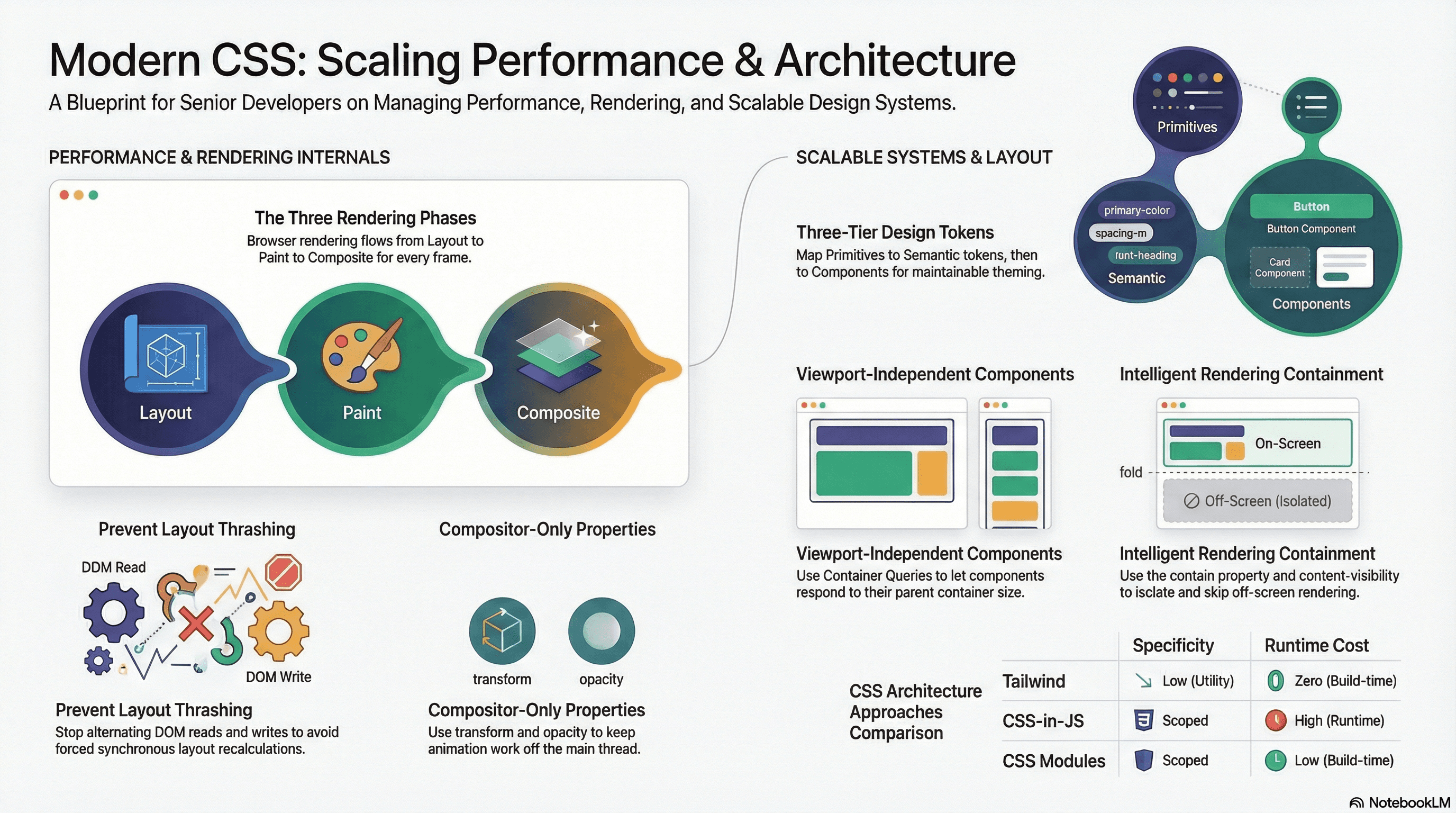
CSS & Layout
This section isn't about CSS syntax — it assumes you know how to write CSS. It's about the performance, architectural, and browser-internals questions that arise when CSS is applied at scale: how the cascade and specificity actually resolve conflicts, why certain properties force layout recalculation, how to contain rendering scope to a subtree, and how to design a token system that survives a design system rewrite.
The section opens with the architectural decision — which CSS approach to use and why — before covering the performance characteristics of CSS and the systems that make it maintainable at scale.
What's Covered
CSS Architecture Tradeoffs — How CSS Modules, Tailwind, runtime CSS-in-JS, and vanilla-extract differ on specificity, runtime cost, RSC compatibility, and scalability. How the CSS cascade and @layer work at the mechanism level. How twMerge and cva solve Tailwind class conflict resolution. Make this decision before writing a line of CSS.
CSS Containment — The contain property declares a subtree as independent from the rest of the page, scoping layout and paint recalculations. content-visibility: auto skips rendering entirely for off-screen content. The side effects of paint containment (new stacking context, clipped overflow) and what contain: style does not do (it doesn't scope CSS custom properties).
Container Queries — Decoupling component responsiveness from the viewport. container-type (inline-size, size) establishes a containment context; @container rules query the nearest ancestor container's dimensions. container-name for targeting specific layout contexts. Container query length units (cqi, cqb, cqw, cqh, cqmin, cqmax) for component-relative sizing. Style queries (@container style(--theme: dark)) for custom property conditions. The implicit containment side effects and how container queries compose with CSS Containment.
Layout Thrashing — What happens when JavaScript alternates between reading geometric properties and writing to the DOM, forcing the browser to synchronously recalculate layout repeatedly in a single frame. The full list of properties that force layout, the read-write batching fix, ResizeObserver as a replacement for polling, and the FastDOM scheduling pattern.
Animation Performance — The three rendering phases (layout, paint, composite) and which CSS properties require which. Why transform and opacity are compositor-only and everything else causes main-thread work. The Web Animations API for programmatic animation, @starting-style for native CSS enter animations, and prefers-reduced-motion as an accessibility requirement.
Theming & Design Tokens — The three-tier token hierarchy (primitives → semantic → component), why components must consume semantic tokens and never primitives, how CSS custom properties implement runtime theming via the cascade, preventing flash of wrong theme, and multi-brand token management with Style Dictionary.
Scroll-Driven Animations — The CSS scroll() and view() timeline functions that replace JavaScript scroll listeners and IntersectionObserver for animation purposes, linking @keyframes to scroll progress or element visibility with compositor-thread performance. Named timelines, animation-range for controlling start/end points, the ScrollTimeline and ViewTimeline JavaScript APIs, and production fallback strategies for browsers without support.
Responsive Design Strategies — Container queries (components responding to container size, not viewport), fluid typography with clamp() and the slope-intercept formula, logical properties for RTL/LTR internationalization, dynamic viewport units (dvh/svh/lvh) fixing the mobile browser chrome problem, and :has() for parent-aware component styles.
React 19 & React Compiler
A deep technical guide to React 19's new APIs — Actions, useActionState, useOptimistic, useFormStatus, the use() hook, ref as a prop, document metadata hoisting — and the React Compiler (React Forget) that eliminates manual memoization by auto-optimizing components, hooks, and JSX at build time.
CSS Architecture Tradeoffs
How CSS Modules, Tailwind, CSS-in-JS, vanilla-extract, and cascade layers compare on specificity, runtime cost, RSC compatibility, and scalability — and how to choose the right approach.