REST vs GraphQL vs tRPC
A practical comparison of REST, GraphQL, and tRPC — N+1 prevention with DataLoader, persisted queries, OpenAPI spec generation with zod-openapi, tRPC subscriptions, REST versioning strategies, and a decision framework for choosing the right paradigm.
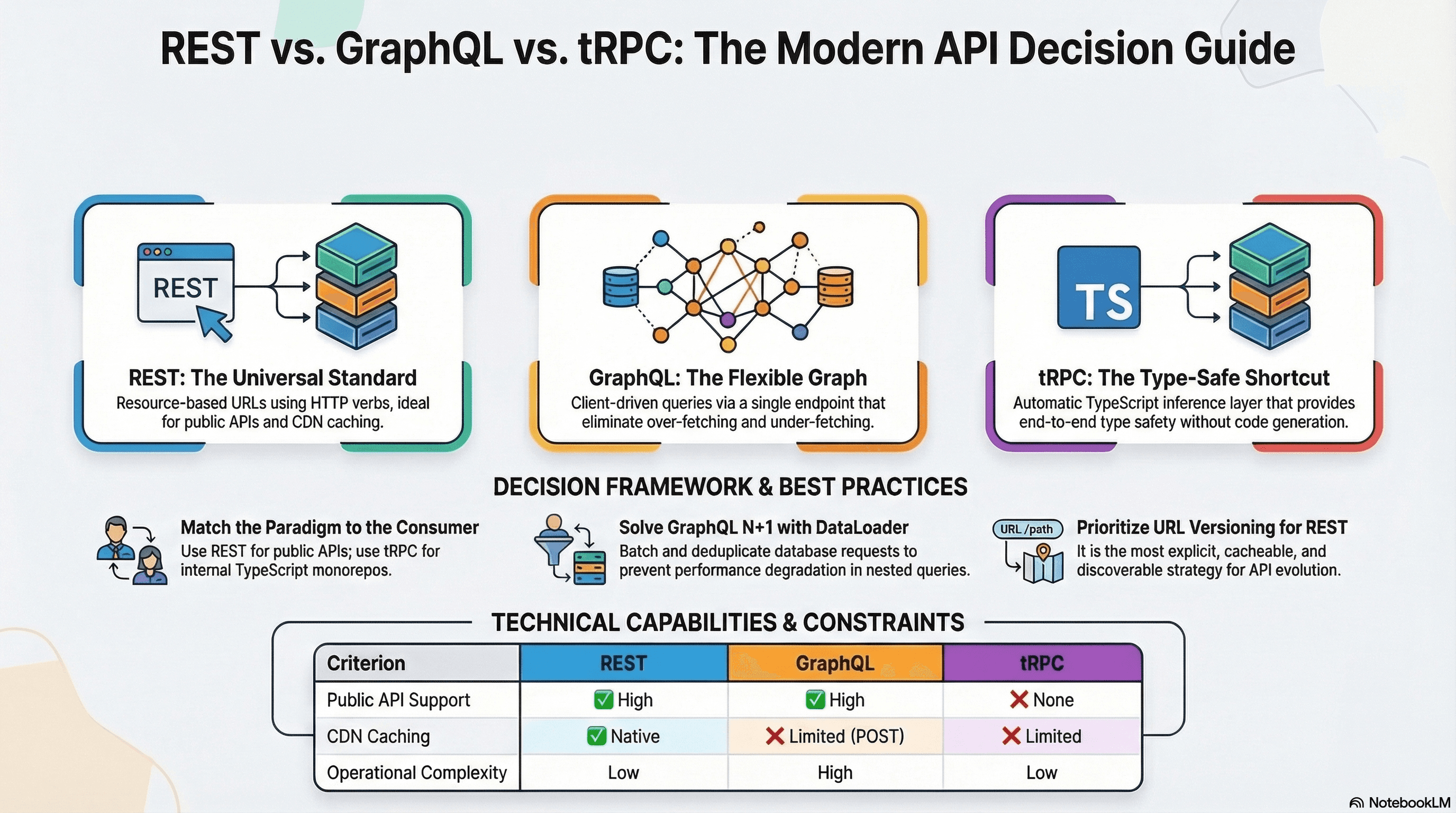
Overview
Three paradigms dominate how frontend and backend communicate in modern TypeScript stacks: REST (resource-based HTTP endpoints), GraphQL (client-driven queries over a single endpoint), and tRPC (end-to-end typesafe RPC over HTTP). Each has a philosophy, a set of tradeoffs, and a class of projects where it excels.
The right choice is determined by two questions: Who are your API consumers? How diverse are their data needs?
How It Works
REST
REST maps operations to HTTP verbs and resource URLs. A GET /products/42 fetches a product; a PATCH /products/42 updates it. The server defines response shapes — clients take what they get.
Strengths: universally understood, language-agnostic, works with CDN caching (GET responses are cacheable by URL), well-tooled with OpenAPI for documentation and codegen.
Weaknesses: over-fetching (fields you don't need) and under-fetching (multiple round-trips to assemble a UI view).
GraphQL
GraphQL exposes a single endpoint (POST /graphql). Clients send a query describing the exact shape they need; the server resolves only those fields. Eliminates over- and under-fetching.
Tradeoffs: operational complexity (schema, resolvers, client-side cache, persisted queries for production, N+1 query prevention). Earns its cost when you have many clients with fundamentally different data requirements.
tRPC
tRPC is not a wire protocol — it's a TypeScript inference layer over HTTP. Server procedures are plain TypeScript functions. Clients call them as async functions. Types flow automatically — no schema file, no codegen step.
Constraint: both client and server must be TypeScript in the same monorepo (or the server types must be published as a package). No stable wire contract for non-TypeScript consumers.
Code Examples
REST — Route Handler with OpenAPI Spec via zod-openapi
npm install @asteasolutions/zod-to-openapi zod// lib/openapi/registry.ts
import {
OpenAPIRegistry,
OpenApiGeneratorV3,
} from "@asteasolutions/zod-to-openapi";
import { z } from "zod";
export const registry = new OpenAPIRegistry();
// Define shared schemas — registered once, reused in route definitions
export const ProductSchema = registry.register(
"Product",
z.object({
id: z.string().uuid(),
name: z.string(),
price: z.number().positive(),
stock: z.number().int().min(0),
}),
);
export const CreateProductSchema = ProductSchema.omit({ id: true });// app/api/products/route.ts
import { NextRequest, NextResponse } from "next/server";
import { z } from "zod";
import {
registry,
ProductSchema,
CreateProductSchema,
} from "@/lib/openapi/registry";
import { db } from "@/lib/db";
// Register the route in the OpenAPI registry for spec generation
registry.registerPath({
method: "get",
path: "/api/products",
tags: ["Products"],
responses: {
200: {
description: "List of products",
content: { "application/json": { schema: z.array(ProductSchema) } },
},
},
});
export async function GET() {
const products = await db.product.findMany({
select: { id: true, name: true, price: true, stock: true },
orderBy: { name: "asc" },
});
return NextResponse.json(products);
}
registry.registerPath({
method: "post",
path: "/api/products",
tags: ["Products"],
request: {
body: { content: { "application/json": { schema: CreateProductSchema } } },
},
responses: {
201: {
description: "Created product",
content: { "application/json": { schema: ProductSchema } },
},
},
});
export async function POST(req: NextRequest) {
const body = CreateProductSchema.parse(await req.json());
const product = await db.product.create({ data: body });
return NextResponse.json(product, { status: 201 });
}// app/api/openapi.json/route.ts — generate spec at runtime
import { OpenApiGeneratorV3 } from "@asteasolutions/zod-to-openapi";
import { registry } from "@/lib/openapi/registry";
export function GET() {
const generator = new OpenApiGeneratorV3(registry.definitions);
const spec = generator.generateDocument({
openapi: "3.0.0",
info: { title: "Products API", version: "1.0.0" },
servers: [{ url: process.env.NEXT_PUBLIC_APP_URL! }],
});
return Response.json(spec);
}REST — API Versioning Strategies
URL versioning (most common, CDN-cacheable, explicit):
// app/api/v1/products/route.ts  → /api/v1/products
// app/api/v2/products/route.ts  → /api/v2/products (new response shape)
Header versioning (cleaner URLs, harder to cache, less discoverable):
// app/api/products/route.ts
export async function GET(req: NextRequest) {
  const version = req.headers.get("api-version") ?? "1";

  if (version === "2") {
    return NextResponse.json(await getProductsV2());
  }
  return NextResponse.json(await getProductsV1());
}
URL versioning is the correct default — it's explicit, copy-pasteable, CDN-cacheable, and works with every HTTP client without special configuration.
GraphQL — DataLoader for N+1 Prevention
Without DataLoader, nested field resolution fires one query per parent record:
// ❌ N+1: 50 orders → 50 separate user queries
resolvers: {
  Order: {
    customer: (order) => db.user.findUnique({ where: { id: order.userId } }),
  },
}
DataLoader batches and deduplicates within a single tick:
// lib/graphql/loaders.ts
import DataLoader from "dataloader";
import { db } from "@/lib/db";

// One loader per request — instantiate fresh per request context to avoid cross-request caching
export function createLoaders() {
  const userLoader = new DataLoader(async (ids: readonly string[]) => {
    const users = await db.user.findMany({ where: { id: { in: [...ids] } } });
    // DataLoader requires results in the same order as the input keys
    return ids.map((id) => users.find((u) => u.id === id) ?? null);
  });

  const productLoader = new DataLoader(async (ids: readonly string[]) => {
    const products = await db.product.findMany({
      where: { id: { in: [...ids] } },
    });
    return ids.map((id) => products.find((p) => p.id === id) ?? null);
  });

  return { userLoader, productLoader };
}
// app/api/graphql/route.ts — pass loaders via context
import { createSchema, createYoga } from "graphql-yoga";
import { createLoaders } from "@/lib/graphql/loaders";
const schema = createSchema({
typeDefs: /* GraphQL */ `
type Order {
id: ID!
total: Float!
customer: User!
}
type User {
id: ID!
name: String!
email: String!
}
type Query {
orders: [Order!]!
}
`,
resolvers: {
Query: {
orders: () => db.order.findMany(),
},
Order: {
// DataLoader batches all customer loads from the same tick into one DB query
customer: (order, _args, ctx) =>
ctx.loaders.userLoader.load(order.userId),
},
},
});
const { handleRequest } = createYoga({
schema,
context: () => ({ loaders: createLoaders() }), // fresh loaders per request
graphqlEndpoint: "/api/graphql",
});
export const GET = handleRequest;
export const POST = handleRequest;GraphQL — Persisted Queries
In production, allow only pre-approved queries. Persisted queries improve security (no arbitrary query injection) and performance (send only the hash over the wire):
// lib/graphql/persisted-queries.ts — generated at build time from .graphql files
export const PERSISTED_QUERIES: Record<string, string> = {
  a1b2c3d4: `query GetProduct($id: ID!) { product(id: $id) { id name price } }`,
  e5f6g7h8: `query ListOrders { orders { id total customer { name } } }`,
};
// app/api/graphql/route.ts — only allow persisted queries in production
const { handleRequest } = createYoga({
schema,
context: () => ({ loaders: createLoaders() }),
graphqlEndpoint: "/api/graphql",
plugins: [
{
onParams({ params, setParams }) {
if (process.env.NODE_ENV !== "production") return;
// In production: only allow requests that include a known query hash
const hash = (params.extensions as any)?.persistedQuery?.sha256Hash;
if (!hash || !PERSISTED_QUERIES[hash]) {
throw new Error("Only persisted queries are allowed in production");
}
// Replace the hash with the actual query
setParams({ ...params, query: PERSISTED_QUERIES[hash] });
},
},
],
});tRPC — Full Setup with createCallerFactory
// server/trpc.ts
import { initTRPC, TRPCError } from "@trpc/server";
import { auth } from "@/auth";

export const t = initTRPC.context<{ userId: string | null }>().create();

export const router = t.router;
export const publicProcedure = t.procedure;

// Protected procedure — throws 401 if not authenticated
export const protectedProcedure = t.procedure.use(async ({ ctx, next }) => {
  if (!ctx.userId) throw new TRPCError({ code: "UNAUTHORIZED" });
  return next({ ctx: { userId: ctx.userId } });
});
// server/routers/product.ts
import { z } from "zod";
import { router, publicProcedure, protectedProcedure } from "../trpc";
import { db } from "@/lib/db";
export const productRouter = router({
list: publicProcedure
.input(
z.object({
cursor: z.string().optional(),
limit: z.number().max(50).default(20),
}),
)
.query(async ({ input }) => {
const products = await db.product.findMany({
take: input.limit + 1,
cursor: input.cursor ? { id: input.cursor } : undefined,
orderBy: { createdAt: "desc" },
});
const hasMore = products.length > input.limit;
return {
items: hasMore ? products.slice(0, -1) : products,
nextCursor: hasMore ? products[products.length - 2].id : null,
};
}),
update: protectedProcedure
.input(z.object({ id: z.string(), price: z.number().positive() }))
.mutation(async ({ input, ctx }) => {
// ctx.userId is guaranteed non-null by protectedProcedure
return db.product.update({
where: { id: input.id },
data: { price: input.price },
});
}),
});// server/root.ts
import { router } from "./trpc";
import { productRouter } from "./routers/product";
export const appRouter = router({ product: productRouter });
export type AppRouter = typeof appRouter;
// createCallerFactory: call procedures directly in Server Components without HTTP
export const createCaller = appRouter.createCaller;// app/api/trpc/[trpc]/route.ts
import { fetchRequestHandler } from "@trpc/server/adapters/fetch";
import { appRouter } from "@/server/root";
import { auth } from "@/auth";
const handler = (req: Request) =>
fetchRequestHandler({
endpoint: "/api/trpc",
req,
router: appRouter,
createContext: async () => {
const session = await auth();
return { userId: session?.user?.id ?? null };
},
});
export { handler as GET, handler as POST };// app/products/page.tsx — Server Component: call tRPC directly, no HTTP round-trip
import { createCaller } from "@/server/root";
import { auth } from "@/auth";
export default async function ProductsPage() {
const session = await auth();
// createCaller bypasses HTTP — calls the procedure function directly
const caller = createCaller({ userId: session?.user?.id ?? null });
const { items } = await caller.product.list({ limit: 20 });
return (
<ul>
{items.map((p) => (
<li key={p.id}>
{p.name} — ${p.price}
</li>
))}
</ul>
);
}tRPC Subscriptions — Real-Time Updates
// server/routers/notifications.ts
import { observable } from "@trpc/server/observable";
import { router, protectedProcedure } from "../trpc";
import { EventEmitter } from "events";

const notificationEmitter = new EventEmitter();

export const notificationsRouter = router({
  onNew: protectedProcedure.subscription(({ ctx }) => {
    return observable<{ message: string; createdAt: Date }>((emit) => {
      const listener = (notification: { userId: string; message: string }) => {
        if (notification.userId === ctx.userId) {
          emit.next({ message: notification.message, createdAt: new Date() });
        }
      };

      notificationEmitter.on("notification", listener);
      // Cleanup when the subscription is unsubscribed
      return () => notificationEmitter.off("notification", listener);
    });
  }),
});

// Emit from anywhere in the server
export function pushNotification(userId: string, message: string) {
  notificationEmitter.emit("notification", { userId, message });
}
// Client component subscribing
"use client";
import { trpc } from "@/lib/trpc-client";
export function NotificationBell() {
trpc.notifications.onNew.useSubscription(undefined, {
onData: (notification) => {
console.log("New notification:", notification.message);
},
});
return <button>🔔</button>;
}tRPC subscriptions require WebSocket or SSE transport — not supported in serverless environments (Vercel, Cloudflare Workers) without a persistent connection layer. For serverless, use SSE via Route Handlers or a separate WebSocket server.
Decision Framework
| Criterion | REST | GraphQL | tRPC |
|---|---|---|---|
| Public API (multiple consumers) | ✅ | ✅ | ❌ |
| Non-TypeScript consumers | ✅ | ✅ | ❌ |
| CDN-cacheable responses | ✅ | ❌ (POST) | ❌ |
| Flexible client queries | ❌ | ✅ | Limited |
| Fastest internal type safety | ❌ | ❌ | ✅ |
| Zero codegen | ✅ | ❌ | ✅ |
| Real-time subscriptions | ❌ native | ✅ | ✅ |
| Operational simplicity | ✅ | ❌ | ✅ |
Real-World Use Case
E-commerce platform. Internal Next.js app → tRPC for all admin and storefront data: type-safe, zero schema, Server Components call procedures directly. Public REST API for third-party mobile apps and partner integrations → Route Handlers with zod-openapi generating the OpenAPI spec automatically. A merchandising partner portal needing custom cross-entity queries (orders + products + inventory) → GraphQL with DataLoader for N+1 prevention and persisted queries in production. Three paradigms, each matched to its consumer.
Common Mistakes / Gotchas
1. Using tRPC for a public API. tRPC has no stable wire contract. Its HTTP calls are implementation details. External consumers must import your TypeScript server types — which creates a versioning and deployment dependency. Use REST or GraphQL.
2. Skipping DataLoader in GraphQL. A customer resolver on Order that calls db.user.findUnique fires one query per order. 50 orders = 51 queries. Always batch with DataLoader.
3. Skipping Zod validation in tRPC. TypeScript inference is compile-time only. Malformed runtime payloads reach your resolver as unknown without .input(schema). Always validate.
4. Using GET for mutations in REST. GET must be idempotent and safe. Next.js prefetches <Link> hrefs on hover — a GET /api/send-email?to=... would fire on every hover. Mutations belong on POST/PUT/PATCH/DELETE.
5. Using GraphQL for a single internal frontend. Adding a schema, resolvers, client cache, and DataLoader for one Next.js frontend that could just use Server Components or tRPC is unnecessary complexity. GraphQL's value scales with consumer diversity.
Summary
REST is the default for public, multi-consumer APIs — universally understood, cacheable, and well-tooled with OpenAPI. GraphQL earns its operational complexity when diverse clients need composable queries over a shared data graph; always use DataLoader and persisted queries in production. tRPC is the fastest path to end-to-end type safety in a TypeScript monorepo — no schema, no codegen, direct procedure calls from Server Components. URL versioning is the correct REST versioning default. Most mature applications use multiple paradigms: tRPC or Server Components internally, REST or GraphQL externally.
Interview Questions
Q1. What is the N+1 query problem in GraphQL and how does DataLoader solve it?
When a GraphQL query returns a list of items and each item has a nested field resolved by a separate database query, you get N+1 queries: 1 query for the list, N queries for each item's nested field. For 50 orders each with a customer field, that's 51 database queries. DataLoader solves this by batching: it collects all load(userId) calls that happen within the same event loop tick, then fires one findMany query for all of them at once. It also deduplicates: if two orders have the same customer, the customer is fetched once and returned to both. The result: 2 queries regardless of list size.
Q2. When should you choose tRPC over REST for a Next.js application?
tRPC is the right choice when your entire stack is TypeScript and the API is consumed only by clients in the same monorepo (or clients that can import the server types). The advantages: no schema to maintain, no codegen step, types flow automatically from server to client via inference, and Server Components can call procedures directly without an HTTP round-trip using createCaller. The constraint: tRPC is not suitable for public APIs, mobile apps in other languages, or third-party integrations — it has no stable wire contract and requires TypeScript on both sides. If you need to expose your API externally, use REST (Route Handlers) or GraphQL alongside tRPC.
Q3. What are persisted queries in GraphQL and why should you use them in production?
In standard GraphQL, clients send the full query string with every request. This has two problems: (1) an attacker can send expensive or malicious queries to your endpoint; (2) large query strings add HTTP overhead. Persisted queries replace the query string with a hash of the query, pre-registered at build time. The client sends only the hash; the server looks up the corresponding query. In production, you can reject any request that doesn't include a known hash — no arbitrary queries allowed. This improves security (no ad-hoc query injection), performance (smaller request payloads), and observability (every query has a stable, loggable ID). Generate the persisted query manifest from your client-side .graphql files as part of the build.
Q4. What is createCallerFactory in tRPC and when should you use it?
createCallerFactory (or the earlier createCaller) creates a server-side function that calls tRPC procedures directly without making an HTTP request. In Server Components, you can call createCaller(ctx).product.list({}) to fetch data from the same procedure that handles API requests — no serialization/deserialization, no network overhead, full type safety. Use it in Server Components, Server Actions, and API route handlers that need to compose multiple procedure calls. This is the idiomatic way to fetch data in App Router Server Components when using tRPC — it avoids the redundant HTTP call that fetch("/api/trpc/...") would make.
Q5. What are the tradeoffs between URL versioning and header versioning for REST APIs?
URL versioning (/api/v1/products, /api/v2/products) is explicit — the version is visible in links, bookmarks, and logs. It's CDN-cacheable by URL, works with every HTTP client without configuration, and is easy to route in middleware. The downside: "unclean" URLs and the client must explicitly update all call sites when upgrading. Header versioning (api-version: 2 header) produces clean URLs and version negotiation is separated from resource addressing. The downsides: not CDN-cacheable by URL alone (requires Vary: api-version), not visible in links or logs, and requires clients to configure request headers. URL versioning is the correct default — its explicitness is a feature, and the CDN cacheability advantage is significant for high-traffic GET endpoints.
Q6. How does GraphQL handle caching compared to REST and what are the workarounds?
REST maps operations to URLs, so GET /products/42 is naturally cacheable by CDN and browser — the URL is the cache key. GraphQL exposes a single POST /graphql endpoint; HTTP caches don't cache POST responses by default, and the same endpoint returns completely different data depending on the query body. Workarounds: (1) Persisted queries over GET — register queries by hash and issue them as GET /graphql?extensions={"persistedQuery":{"sha256Hash":"abc123"}} — now the response is cacheable by URL+query-hash; (2) Client-side normalized cache — Apollo Client and urql cache at the entity level using __typename + id as the cache key, deduplicating and updating entities across queries; (3) CDN with query-aware caching — some CDNs (Fastly, Cloudflare) can be configured to cache GraphQL responses based on the query body hash.
Authentication Flows
OAuth 2.0 Authorization Code Flow with PKCE, JWT structure and storage tradeoffs, session cookies, refresh token rotation with reuse detection, silent refresh, and Auth.js v5 integration in Next.js App Router.
Client-Side Rate Limiting
Handling 429 responses gracefully — exponential backoff with full/equal jitter, token bucket vs leaky bucket models, in-flight request deduplication, X-RateLimit header standards, priority queue patterns, and proactive client-side throttling.