Overview
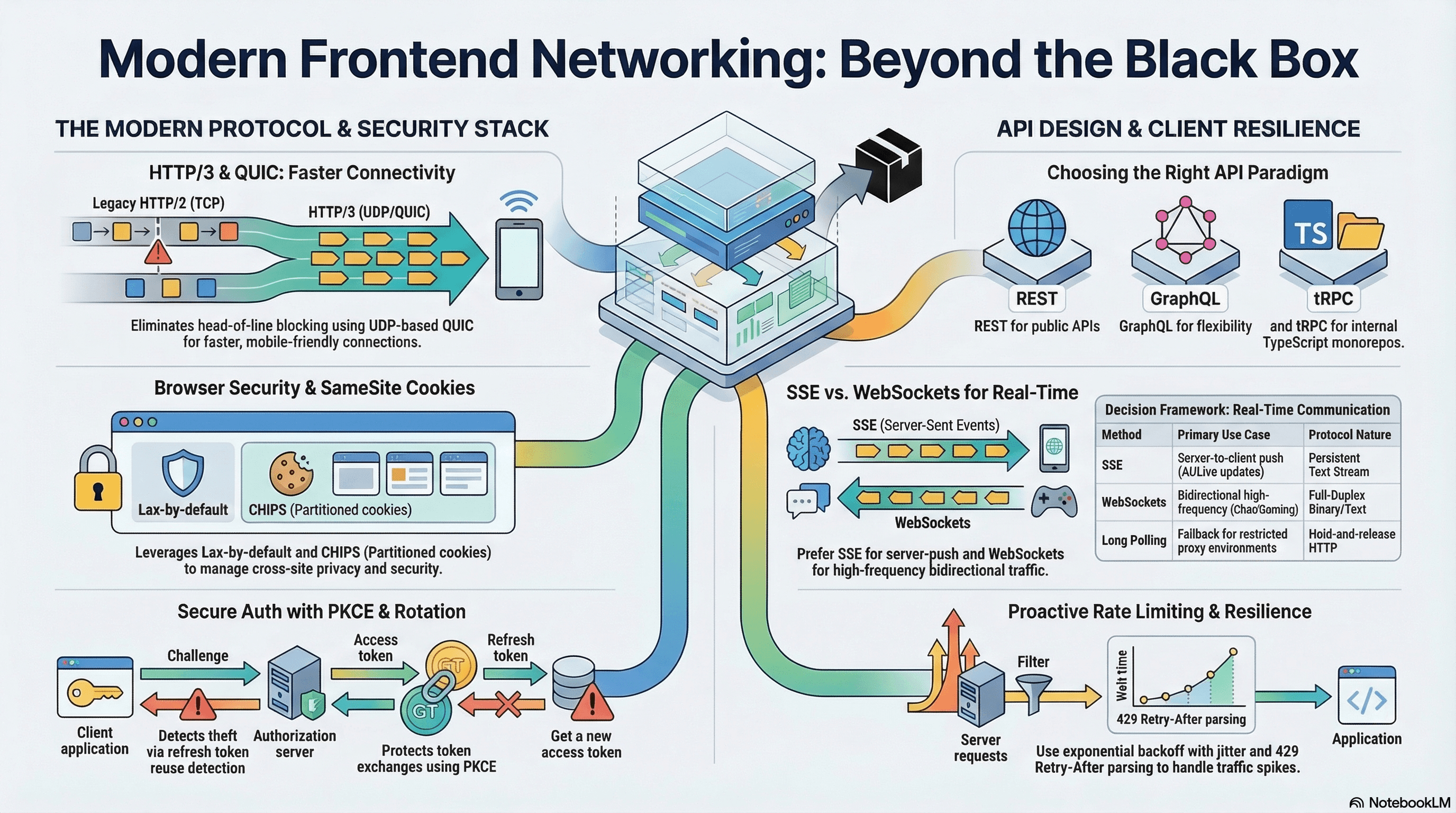
The network layer between your frontend and the server — HTTP evolution, browser security policies, authentication flows, API design paradigms, and client-side resilience patterns.
Networking & Protocols
Frontend engineers interact with the network constantly but often treat it as a black box. Understanding the protocols, security boundaries, and authentication models at this layer is essential for building reliable, secure applications — and for diagnosing the class of bugs that only appear in production.
The section moves from the transport layer upward through browser security policy, identity, API design, and client resilience.
What's Covered
HTTP/3 & QUIC — How HTTP/3 eliminates transport-layer head-of-line blocking by running streams independently over QUIC (UDP-based) rather than TCP's single ordered byte stream. QUIC's 1-RTT connection setup, 0-RTT session resumption for returning clients (and its replay-vulnerability requiring idempotent-only use), Connection IDs enabling seamless IP migration, and BBR congestion control outperforming CUBIC on lossy mobile links. Alt-Svc header-based HTTP/3 discovery vs HTTPS DNS SVCB records for first-request HTTP/3. UDP firewall detection and automatic TCP fallback. Verifying protocol usage with PerformanceResourceTiming.nextHopProtocol in RUM pipelines.
CORS & Preflight — The Same-Origin Policy as the underlying browser rule and CORS as its server-controlled relaxation. Simple vs non-simple request classification (the Content-Type: application/json and Authorization header triggers). The preflight OPTIONS handshake with Access-Control-Allow-Origin, Allow-Methods, Allow-Headers, and Max-Age for caching. Credentialed requests (credentials: 'include') and why wildcards are forbidden with credentials. Access-Control-Expose-Headers for custom response header access. Chrome's Private Network Access additional preflight for public→private address requests. The null origin from sandboxed iframes and why reflecting it is dangerous. A DevTools debugging workflow for CORS errors.
SameSite Cookie Modes — Strict, Lax, and None mode comparison with the full cross-site request matrix. The eTLD+1 same-site calculation and why app.example.com and api.example.com are same-site. Chrome 80's Lax-by-default change and how it broke unattributed third-party cookies. __Host- and __Secure- cookie prefixes as browser-enforced security guarantees. CHIPS (Partitioned cookies) for third-party iframe contexts that survive third-party cookie deprecation. Safari ITP restrictions on SameSite=None cookies and the Storage Access API. Why Strict breaks OAuth redirect flows and password manager links.
Authentication Flows — OAuth 2.0 Authorization Code Flow with PKCE: code_verifier/code_challenge generation, state parameter CSRF protection, back-channel token exchange. id_token vs access_token vs refresh_token — what each is for and who should see it. JWT structure (header.payload.signature), httpOnly cookie storage vs localStorage (XSS risk matrix). Refresh token rotation with reuse detection — detecting token theft by recognizing a used token being presented again and revoking the entire token family. Silent refresh with in-flight deduplication to prevent the rotation race condition. Auth.js v5 setup for Next.js App Router.
REST vs GraphQL vs tRPC — REST with zod-openapi for automatic OpenAPI spec generation. URL vs header API versioning tradeoffs (cacheability, discoverability, client configuration). GraphQL N+1 prevention with DataLoader (batching + deduplication within a tick). Persisted queries for production security and performance. tRPC with createCallerFactory for direct procedure calls in Server Components without HTTP round-trips. tRPC subscriptions over WebSocket/SSE. Decision framework: REST for public/multi-consumer APIs, GraphQL for diverse-consumer query flexibility, tRPC for internal TypeScript monorepos.
WebSockets vs SSE vs Long Polling — Three real-time communication strategies compared at the protocol level. Long polling: hold-and-release HTTP cycle with server-side timeout (20–30s under proxy limits), exponential backoff with jitter on failure, lastId-based resumption. SSE: persistent text/event-stream connection with the four SSE fields (data:, event:, id:, retry:), Last-Event-ID auto-reconnection for gap-free resumption, named events for multiplexing streams over a single EventSource, and the HTTP/1.1 six-connection-per-origin limit (solved by HTTP/2 multiplexing). WebSockets: HTTP Upgrade handshake with Sec-WebSocket-Key/Accept verification, frame types (text 0x1, binary 0x2, close 0x8, ping 0x9, pong 0xA), client-to-server frame masking to prevent proxy cache poisoning, server-side heartbeat (ping/pong) for dead connection detection. AI token streaming as the dominant SSE use case (OpenAI-style text/event-stream). Reusable useWebSocket hook with auto-reconnect and exponential backoff. Decision framework: default to SSE for server-push, WebSockets only for bidirectional high-frequency communication, long polling only as a proxy-constrained fallback.
Client-Side Rate Limiting — Parsing 429 responses: Retry-After as both number-of-seconds and HTTP-date formats, X-RateLimit-Reset Unix timestamp. Exponential backoff with full jitter (random(0, min(cap, base × 2^n))) vs equal jitter for minimum wait guarantees. Retryable vs non-retryable status codes (only 429 and 5xx). In-flight request deduplication via a Promise map to prevent quota waste from concurrent identical requests. Token bucket proactive throttling — burst-allowing, rate-enforcing. Priority queue pattern for protecting user-initiated actions from background traffic. Live countdown UI with automatic re-enable after the rate window resets.
Navigation API — The purpose-built browser API for SPA navigation, replacing History.pushState/popstate which was designed for session history, not client-side routing. navigation.navigate() with state and info options, the NavigateEvent with intercept({ handler }) for async transitions, navigation.entries() for full history inspection (unlike History API which only exposes length), NavigationHistoryEntry with stable key for deterministic traverseTo(). Back/forward detection via entry index comparison — impossible with the History API. Transition tracking with navigation.transition.finished. Chromium-only (Chrome 102+); progressive enhancement with History API fallback.
IndexedDB
The browser's structured storage database — transactions, indexes, cursors, the idb wrapper, storage estimation, OPFS comparison, and a complete guide to choosing between localStorage, sessionStorage, Cache API, and IndexedDB.
HTTP/3 & QUIC
How HTTP/3 eliminates transport-layer head-of-line blocking by running over QUIC — 0-RTT session resumption, connection migration, BBR congestion control, HTTPS DNS SVCB records, UDP firewall fallback, and how to verify the protocol in production.