Derived vs Redundant State
How to identify and eliminate redundant state — values that can be computed from existing state — and the tools React, Zustand, and Jotai provide to express derivation correctly.
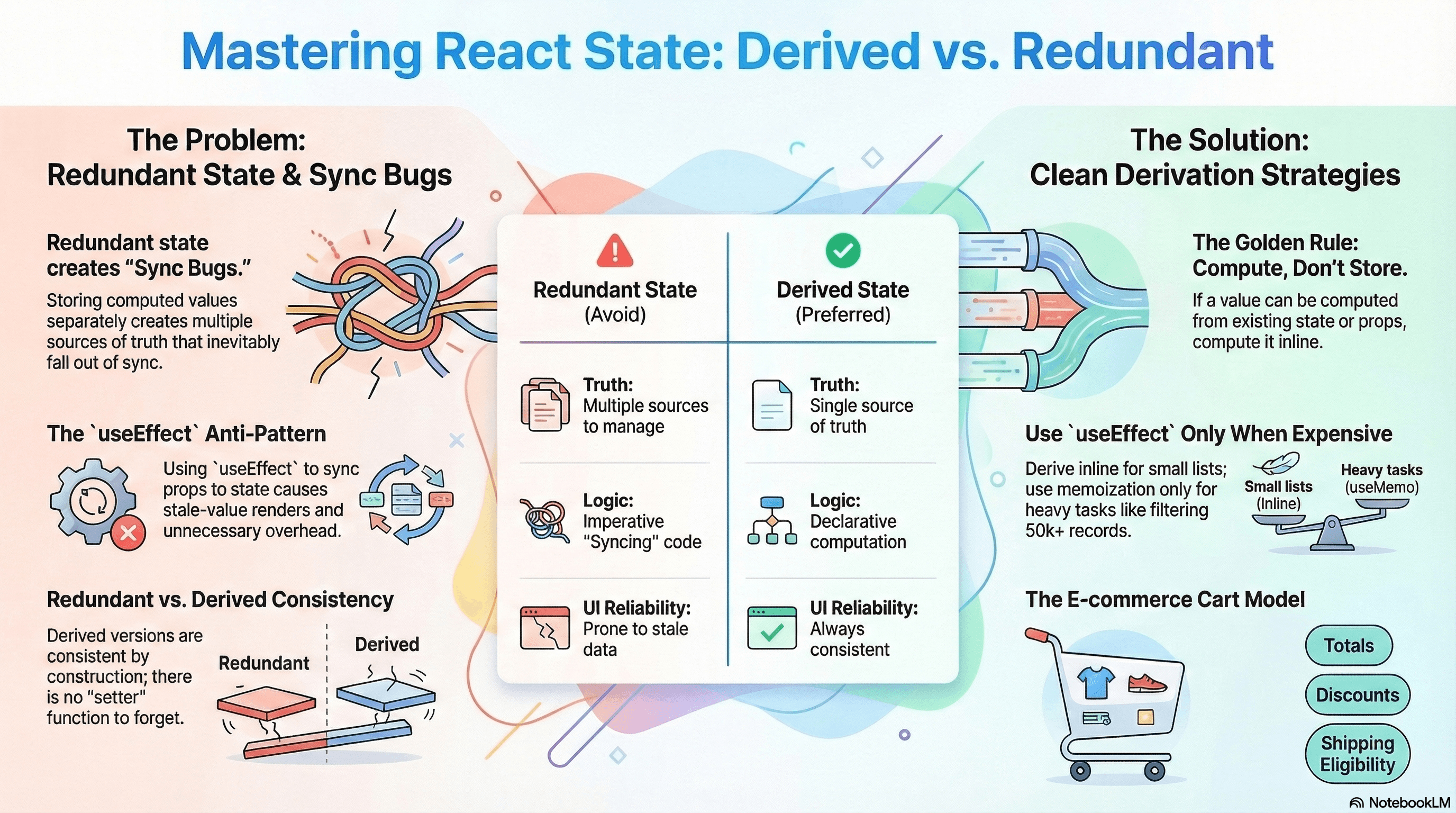
Overview
Derived state is any value you can compute from existing state, props, or fetched data. Redundant state is when you store that computed value separately instead of deriving it — creating two sources of truth that must stay in sync.
Sync bugs are almost always caused by redundant state. You update the primary source but forget to update the copy. Or you update both but in the wrong order. The useEffect that watches one value to update another is the signature of this problem.
The rule is simple: if a value can be computed from something else, don't store it — compute it.
How It Works
The Core Problem
// ❌ Redundant state — two sources of truth
const [items, setItems] = useState<CartItem[]>([]);
const [totalPrice, setTotalPrice] = useState(0); // derived from items

function addItem(item: CartItem) {
  setItems((prev) => [...prev, item]);
  setTotalPrice((prev) => prev + item.price); // easy to forget or get wrong
}

// ✅ Single source of truth — derive on every render
const [items, setItems] = useState<CartItem[]>([]);
const totalPrice = items.reduce((sum, item) => sum + item.price, 0); // always correct
The derived version is always consistent by construction. There is no setTotalPrice to forget.
When Derivation Is Expensive
For cheap computations (summing an array, filtering a list under 1000 items, string concatenation), derive inline. For genuinely expensive computations — filtering 50,000 records, running a graph algorithm, complex aggregation — use useMemo with the source data as a dependency:
// Derive inline for cheap work
const isEmpty = items.length === 0;
const fullName = `${firstName} ${lastName}`;

// useMemo only when the derivation has a measurable cost
const expensiveResult = useMemo(
  () => runGraphAlgorithm(largeDataset),
  [largeDataset],
);
useMemo is a performance optimization, not a solution to redundant state. It still derives — it just caches the result.
Code Examples
Anti-Pattern: useEffect to Sync State from Props
The most common form of redundant state. If you need a "processed" version of a prop, derive it inline or with useMemo. A useEffect that syncs prop → state always produces at least one render with the stale value.
// ❌ useEffect sync — always renders once with stale data
function UserCard({ user }: { user: User }) {
  const [displayName, setDisplayName] = useState("");

  useEffect(() => {
    // Runs AFTER the first render — component briefly shows "" instead of the name
    setDisplayName(`${user.firstName} ${user.lastName}`);
  }, [user.firstName, user.lastName]);

  return <h2>{displayName}</h2>; // shows "" on first render
}

// ✅ Derived — always correct on every render
function UserCard({ user }: { user: User }) {
  const displayName = `${user.firstName} ${user.lastName}`; // always current
  return <h2>{displayName}</h2>;
}
Correct Pattern: useReducer for State That Must Change Together
When multiple state values always change together based on the same event, co-locate them in a reducer. The reducer derives the full next state from the action — you can't update one slice and forget another.
// ❌ Multiple useState calls that must stay in sync
const [items, setItems] = useState<CartItem[]>([]);
const [discount, setDiscount] = useState(0);
const [promoApplied, setPromoApplied] = useState(false);

// Easy to forget to set promoApplied when applying a promo
function applyPromo(code: string) {
  const d = calculateDiscount(code, items);
  setDiscount(d);
  // setPromoApplied(true); ← easy to forget
}
// ✅ useReducer — all related state transitions are atomic
type CartState = {
items: CartItem[];
discount: number;
promoCode: string | null;
};
type CartAction =
| { type: "ADD_ITEM"; item: CartItem }
| { type: "REMOVE_ITEM"; id: string }
| { type: "APPLY_PROMO"; code: string };
function cartReducer(state: CartState, action: CartAction): CartState {
switch (action.type) {
case "ADD_ITEM":
return { ...state, items: [...state.items, action.item] };
case "REMOVE_ITEM":
return {
...state,
items: state.items.filter((i) => i.id !== action.id),
};
case "APPLY_PROMO":
// All three change together — impossible to forget one
return {
...state,
discount: calculateDiscount(action.code, state.items),
promoCode: action.code,
};
}
}
function Cart() {
const [state, dispatch] = useReducer(cartReducer, {
items: [],
discount: 0,
promoCode: null,
});
// Derive from state — never stored separately
const subtotal = state.items.reduce((s, i) => s + i.price * i.quantity, 0);
const total = subtotal - state.discount;
const itemCount = state.items.reduce((s, i) => s + i.quantity, 0);
return (
<div>
<p>
{itemCount} items — Subtotal: ${subtotal.toFixed(2)}
</p>
{state.discount > 0 && <p>Discount: -${state.discount.toFixed(2)}</p>}
<p>Total: ${total.toFixed(2)}</p>
<button onClick={() => dispatch({ type: "APPLY_PROMO", code: "SAVE10" })}>
Apply promo
</button>
</div>
);
}Zustand: Computed Selectors (Not Computed State)
In Zustand, derived values belong in selectors, not in the store itself. The store holds only the minimal state; components derive what they need:
// lib/stores/cart-store.ts
import { create } from "zustand";

interface CartItem {
  id: string;
  name: string;
  price: number;
  quantity: number;
}

interface CartStore {
  items: CartItem[];
  addItem: (item: Omit<CartItem, "quantity">) => void;
  removeItem: (id: string) => void;
  updateQty: (id: string, quantity: number) => void;
  // ❌ Don't put totalPrice or itemCount in the store — they're derivable
}

export const useCartStore = create<CartStore>((set) => ({
  items: [],

  addItem: (incoming) =>
    set((state) => {
      const exists = state.items.find((i) => i.id === incoming.id);
      if (exists) {
        return {
          items: state.items.map((i) =>
            i.id === incoming.id ? { ...i, quantity: i.quantity + 1 } : i,
          ),
        };
      }
      return { items: [...state.items, { ...incoming, quantity: 1 }] };
    }),

  removeItem: (id) =>
    set((state) => ({ items: state.items.filter((i) => i.id !== id) })),

  updateQty: (id, quantity) =>
    set((state) => ({
      items: state.items.map((i) => (i.id === id ? { ...i, quantity } : i)),
    })),
}));
// components/CartSummary.tsx — derive in the selector, not in the store
"use client";
import { useCartStore } from "@/lib/stores/cart-store";
export function CartSummary() {
// Selectors derive — components only re-render when the derived value changes
const itemCount = useCartStore((s) =>
s.items.reduce((n, i) => n + i.quantity, 0),
);
const totalPrice = useCartStore((s) =>
s.items.reduce((sum, i) => sum + i.price * i.quantity, 0),
);
return (
<footer>
<p>{itemCount} items</p>
<p>Total: ${totalPrice.toFixed(2)}</p>
</footer>
);
}
// components/CartIcon.tsx — subscribes only to itemCount, not total
export function CartIcon() {
// Only re-renders when itemCount changes — not on price changes
const itemCount = useCartStore((s) =>
s.items.reduce((n, i) => n + i.quantity, 0),
);
return <span aria-label={`${itemCount} items in cart`}>🛒 {itemCount}</span>;
}Jotai: Derived Atoms
Jotai's atom() function accepts a read function — making derivation a first-class primitive:
// lib/atoms/cart.ts
import { atom } from "jotai";

interface CartItem {
  id: string;
  name: string;
  price: number;
  quantity: number;
}

// Base atom — the single source of truth
export const cartItemsAtom = atom<CartItem[]>([]);

// Derived atoms — computed from cartItemsAtom, always in sync
export const itemCountAtom = atom((get) =>
  get(cartItemsAtom).reduce((n, i) => n + i.quantity, 0),
);

export const totalPriceAtom = atom((get) =>
  get(cartItemsAtom).reduce((sum, i) => sum + i.price * i.quantity, 0),
);

export const emptyCartAtom = atom((get) => get(cartItemsAtom).length === 0);

// Derived + filtered — items above a price threshold
export const expensiveItemsAtom = atom((get) =>
  get(cartItemsAtom).filter((i) => i.price > 100),
);
// components/CartStatus.tsx
"use client";
import { useAtomValue } from "jotai";
import { itemCountAtom, totalPriceAtom, emptyCartAtom } from "@/lib/atoms/cart";
export function CartStatus() {
const count = useAtomValue(itemCountAtom); // re-renders only when count changes
const total = useAtomValue(totalPriceAtom); // re-renders only when total changes
const isEmpty = useAtomValue(emptyCartAtom); // re-renders only when empty/not-empty flips
if (isEmpty) return <p>Your cart is empty.</p>;
return (
<p>
{count} item{count !== 1 ? "s" : ""} — ${total.toFixed(2)}
</p>
);
}Jotai's derived atoms are lazy and memoized — they only recompute when their source atoms change, and they only notify subscribers when their own output changes.
Normalizing Complex Derived Filters
// ❌ Storing a filtered list — must sync whenever items or filter changes
const [products, setProducts] = useState<Product[]>([]);
const [filteredProducts, setFiltered] = useState<Product[]>([]);
const [filter, setFilter] = useState("all");

useEffect(() => {
  setFiltered(
    filter === "all" ? products : products.filter((p) => p.category === filter),
  );
}, [products, filter]);

// ✅ Derive the filtered list — zero sync bugs possible
const [products, setProducts] = useState<Product[]>([]);
const [filter, setFilter] = useState("all");

const filteredProducts = useMemo(
  () =>
    filter === "all" ? products : products.filter((p) => p.category === filter),
  [products, filter],
);
Real-World Use Case
E-commerce cart. A cart has items: CartItem[] as its single source of truth. Every other cart value — subtotal, total with discount, item count, whether the cart is empty, whether free shipping applies (subtotal ≥ $50), eligible discount tier — is derived. Storing any of these as separate state means every cart mutation (add, remove, change quantity, apply promo) must update every derived field. Miss one update and the UI lies to the user. Derive them all and the UI is always consistent by construction, with zero sync logic.
Common Mistakes / Gotchas
1. Using useEffect to sync state from props. This always produces at least one render with a stale value and adds re-render overhead. Derive inline or with useMemo.
2. Storing filtered or sorted lists as state. Sorting and filtering are cheap. Derive them every render or memoize if the source list is large.
3. Storing booleans derivable from other values.
// ❌ isEmpty must be kept in sync with items
const [isEmpty, setIsEmpty] = useState(true);

// ✅ Always correct
const isEmpty = items.length === 0;
4. Over-using useMemo to avoid "redundant" work. Memoization has its own overhead. For cheap inline computations, useMemo is slower than just computing. Measure before optimizing.
5. Putting derived values in a Zustand store. Derived values don't belong in the store definition. They belong in selectors that components read. Putting them in the store means writing additional actions to keep them up to date.
Summary
Derived state is any value computable from existing state or props — and computing it inline is always preferable to storing a copy. Redundant state creates multiple sources of truth requiring useEffect sync logic, which produces stale-value renders and sync bugs. useReducer co-locates state that must change together, preventing partial updates. Zustand selectors and Jotai derived atoms bring the same principle to global state — derive in the read path, not in the store definition. Use useMemo only when derivation has a measurable performance cost.
Interview Questions
Q1. What is redundant state and how do you identify it?
Redundant state is any value stored in state that can be computed from other state, props, or fetched data. You can identify it by asking: "If I only had the other values, could I always reconstruct this one?" If yes, it's redundant. The signature pattern is a useEffect that watches some value and calls a setter to update a "derived" value — that setter and that state are redundant. The fix is to remove the state and compute the value inline (or with useMemo if expensive). Redundant state almost always causes sync bugs because it creates two sources of truth that must be kept in sync by imperative code.
Q2. When should you use useMemo for derived state versus computing inline?
Compute inline for cheap derivations — string concatenation, boolean checks, summing a small array, filtering a list of under ~1000 items. The overhead of useMemo (dependency comparison, cached value storage) exceeds the cost of the derivation itself for cheap operations. Use useMemo when: the computation has a measurable performance cost (large dataset filtering, graph algorithms, complex aggregations), when the derived value is an object or array that will be used as a prop for a memoized child component (referential stability matters), or when profiling identifies the derivation as a bottleneck. Never use useMemo as a default — it adds complexity without benefit for most derivations.
Q3. How does useReducer help prevent redundant state?
useReducer co-locates all related state transitions in one function. When multiple state values must always change together (a cart's items + discount + promo code), the reducer enforces that they change atomically. There's no setDiscount to forget — the reducer updates all fields in one return. This is the right tool when you have multiple pieces of state that participate in the same events. It replaces a set of coordinated useState calls (where you can forget a setter) with a single transition function (where the full next state is derived from the action).
Q4. What's the difference between derived state in a Zustand selector vs a Jotai derived atom?
Zustand selectors are functions passed to useStore — they run on every store update and the component re-renders only when the selector's return value changes (by reference or value equality). Selectors are not cached between components — two components using the same selector each run their own computation. Jotai derived atoms are cached globally — they recompute only when their source atoms change, and the result is shared across all subscribers. Both approaches keep derived values out of the store definition (the right approach), but Jotai's atom model provides global memoization across components while Zustand's selector model is per-component.
Q5. Why is useEffect for prop-to-state synchronization an anti-pattern?
useEffect runs after rendering — after the browser has painted. If you use it to sync prop changes to state, the component renders once with the stale state value, then re-renders with the updated value. This causes a visible flash or incorrect intermediate state. Additionally, it creates a dependency chain that's easy to get wrong: if the effect has missing dependencies, it silently uses stale props. The correct pattern is to derive the value inline during render — it's always computed from the current props with no delay and no extra re-render. getDerivedStateFromProps was the class component anti-pattern equivalent; React's own docs discourage it for the same reasons.
Q6. How should you model derived state in Jotai and what makes derived atoms efficient?
In Jotai, create a base atom with atom(initialValue) for the source of truth, then create derived atoms with atom((get) => get(baseAtom) /* computation */). Derived atoms are lazy — they only compute when a component subscribed to them renders. They are also memoized — Jotai caches the result and only recomputes when the source atoms change. A derived atom notifies its subscribers only when its own output changes (not whenever the source atom changes — if the output is the same, no re-render). This means emptyCartAtom (a boolean) only triggers re-renders twice in the lifetime of a session: once when the cart goes from empty to non-empty, and once when it returns to empty — regardless of how many items are added.
Overview
How state flows through an application — including the edge cases that cause subtle, hard-to-reproduce bugs in production UI.
Immutable Data Patterns
How structural sharing makes immutable updates efficient, why referential equality drives React's rendering model, Immer for deep updates, and Immer middleware for Zustand.