Overview
How state flows through an application — including the edge cases that cause subtle, hard-to-reproduce bugs in production UI.
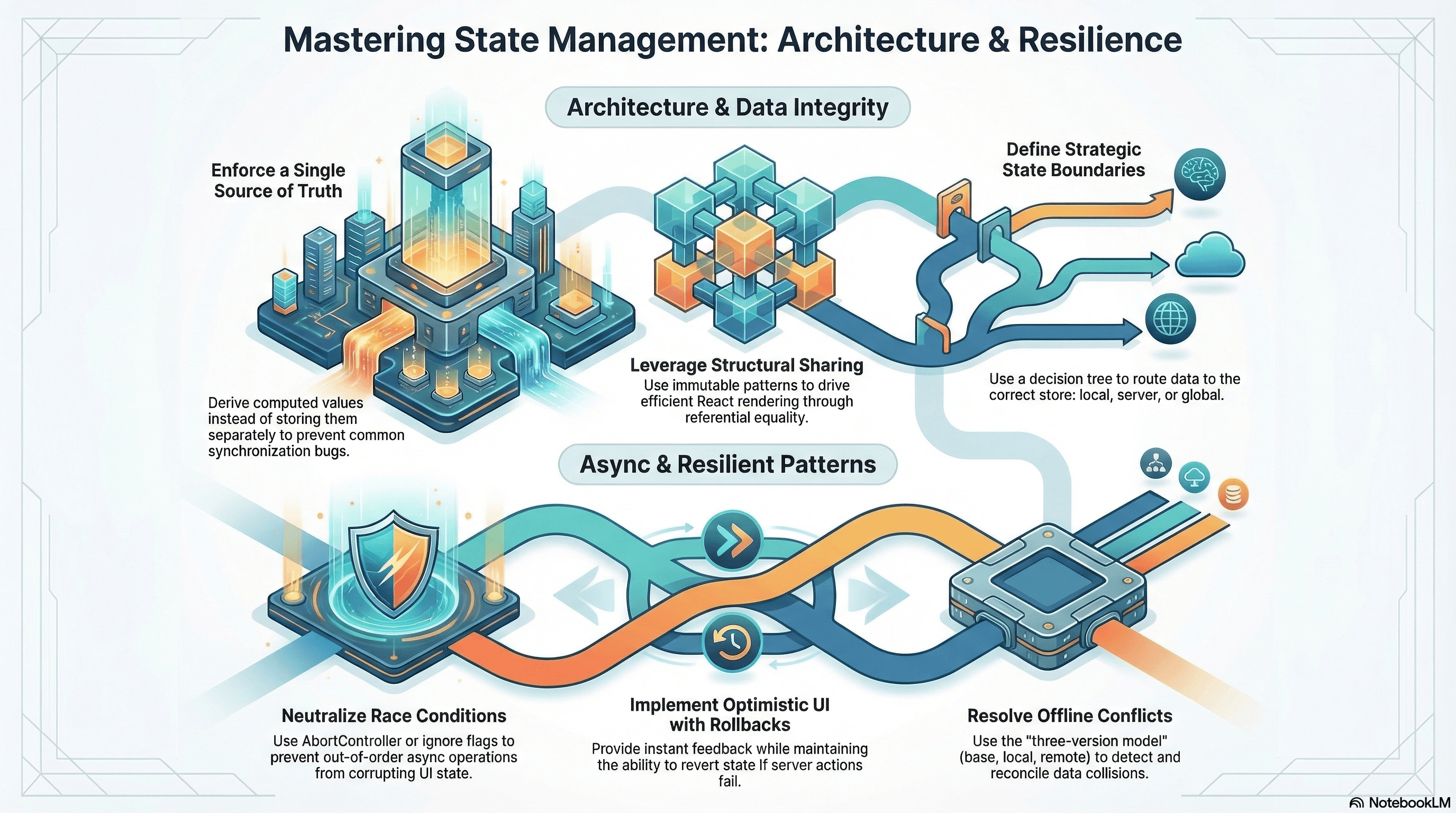
State Management & Data Patterns
Most state management articles focus on which library to use. This section focuses on the underlying problems all state management approaches must solve: consistency, derivation, race conditions, and the boundary between server and client truth.
The section builds from first principles — what state is and where it should live — through remote data patterns, and into the edge cases that only appear under load or poor connectivity.
What's Covered
Derived vs Redundant State — The single source of truth principle and how to enforce it. Redundant state (values stored separately that could be computed) is the root cause of sync bugs. Covers inline derivation, useMemo, useReducer for atomic transitions, Zustand computed selectors, and Jotai derived atoms.
Immutable Data Patterns — How structural sharing makes immutable updates efficient and how referential equality drives React's rendering model. Covers spread patterns, Immer for deep updates, Immer middleware for Zustand, structuredClone vs spread, and how React.memo depends on structural sharing to work correctly.
Memoization Pitfalls — The stale closure problem, when useMemo/useCallback help vs hurt, useEffectEvent (React 19) for stable callbacks that read fresh values, React.memo with custom comparators, the React Compiler's automatic memoization, and how to profile before optimizing.
State Boundaries — How to decide what lives in local state, server state, or global client state. Decision tree for routing state to the right tool. Context splitting by update frequency. useSyncExternalStore for external subscriptions. Zustand with devtools/persist/immer middleware. Jotai's atomic model.
URL as State — Encoding UI state in the URL for shareability, bookmarkability, and server rendering. The mergeSearchParams utility, nuqs for type-safe typed params, Zod validation of URL params before use, push vs replace routing semantics, and the Next.js App Router searchParams prop in Server Components.
Data Fetching Patterns — TanStack Query and SWR as client-side cache managers. Cache keys, deduplication, staleTime vs gcTime. prefetchQuery + dehydrate/HydrationBoundary for SSR-rendered pages with a pre-populated cache. Parallel useQueries, dependent queries with enabled, and mutations with onSuccess cache invalidation.
Race Conditions in UI State — How async operations resolving out of order corrupt displayed state. AbortController for fetch cancellation, ignore flags for non-cancellable async work, useReducer sequence counters for complex state machines, debounce + abort combined, and how TanStack Query eliminates the entire class automatically.
Optimistic UI & Rollback — useOptimistic (React 19) for Server Actions, TanStack Query onMutate/onError/onSettled for client mutations, handling concurrent mutations on the same resource, drag-and-drop snapshot-at-drag-start rollback, and cancelQueries before applying optimistic updates.
Idempotent UI Actions — Client-side guards (disabled state, useTransition, useRef key) for UX. Server-side idempotency keys for correctness. useRef for stable key generation across retries. React Strict Mode as an idempotency test. Idempotency key TTL considerations.
Offline Conflict Resolution — The three-version model (base, local, remote) for conflict detection. Version number and vector clock approaches. IndexedDB write queue for durable offline storage. Background Sync API for flush-on-reconnect even when the page is closed. CRDTs (Automerge, Yjs) for conflict-free collaborative data. Sequential vs parallel queue flushing.
Portal & Layering Architecture
How to build a robust z-index system for tooltips, modals, toasts, and dropdowns using React portals, the native dialog element, stacking contexts, and the inert attribute.
Derived vs Redundant State
How to identify and eliminate redundant state — values that can be computed from existing state — and the tools React, Zustand, and Jotai provide to express derivation correctly.